

GCSE
Biology
-
Introduction to GCSE Biology (AQA) Coming soon
-
1.1 Cell Structure
-
1.2 Cell Division Coming soon
-
1.3 Transport in Cells Coming soon
-
2.1 Principles of Organisation Coming soon
-
2.2 Animal Tissues, Organs and Organ Systems Coming soon
-
2.3 Plant Tissues, Organs and Systems Coming soon
-
3.1 Communicable Diseases Coming soon
-
3.2 Monoclonal Antibodies [HT] Coming soon
-
3.3 Plant Disease Coming soon
-
4.1 Photosynthesis Coming soon
-
4.2 Respiration Coming soon
-
5.1 Homeostasis Coming soon
-
5.2 The Human Nervous System Coming soon
-
5.3 Hormonal Coordination in Humans Coming soon
-
5.4 Plant Hormones Coming soon
-
6.1 Reproduction Coming soon
-
6.2 Variation and Evolution Coming soon
-
6.3 The Development of Understanding of Genetics and Evolution Coming soon
-
6.4 Classification of Living Organisms Coming soon
-
7.1 Adaptations, Interdependence and Competition Coming soon
-
7.2 Organisation of an Ecosystem Coming soon
-
7.3 Biodiversity and the Effect of Human Interaction on Ecosystems Coming soon
-
7.4 Trophic Levels in an Ecosystem Coming soon
-
7.5 Food Production Coming soon
1. Cell Biology
In this lesson, we will explore the structures of the eye and their functions, including accommodation and adaptation to light. We will also examine common eye defects and their treatments. We will learn how these conditions affect the focusWhat the writer draws attention to at a given moment (e.g., setting, character, detail). of light onto the retina and how spectacle lenses can be used to correct them. Additionally, we will interpret ray diagrams to visually demonstrate the corrective effects of spectacle lenses.
The Eye
The eye is a remarkable sense organA structure made of different tissues working together to perform a specific function. that allows us to perceive and interpret the world around us through the sense of sight. It consists of various structures, each with a specific function that contributes to our ability to see clearly and adapt to different visual conditions.
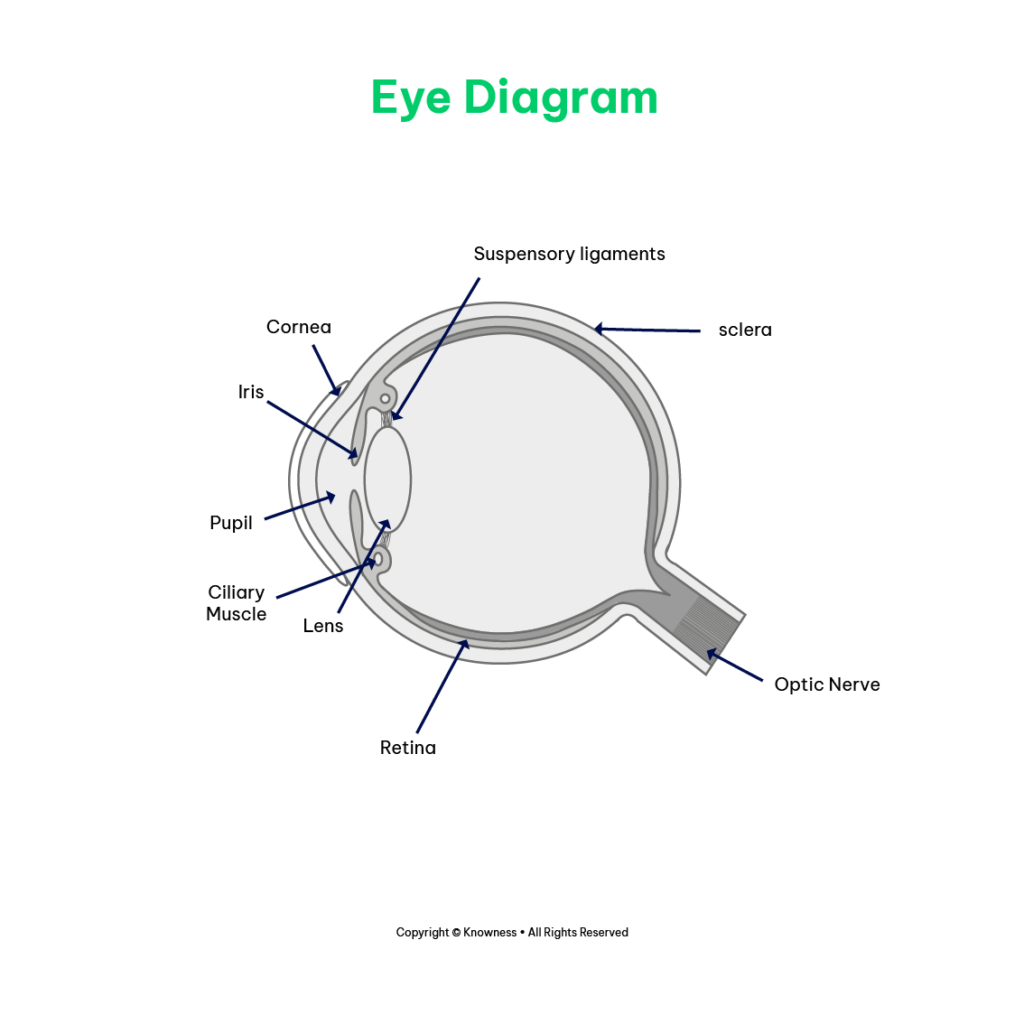
Retina:
- Function: The retina is the innermost layer of the eye that contains specialised cells called photoreceptors, which detect and convert light into electrical signals.
- Role: The retina plays a crucial role in the formation of visual images by transmitting electrical impulses to the brain via the optic nerve.
Optic Nerve:
- Function: The optic nerve is a bundle of nerve fibres that carries visual information from the retina to the brain for processing and interpretation.
- Role: It serves as the communication pathway between the eye and the brain, allowing us to perceive and make sense of visual stimuli.
Sclera:
- Function: The sclera is the tough, outermost layer of the eye.
- Role: It provides structural support and protection for the delicate internal structures of the eye.
Cornea:
- Function: The cornea is the transparent, curved structureThe organisation and order of information in a text. located at the front of the eye.
- Role: It helps to focus incoming light onto the retina, contributing to clear vision.
Iris:
- Function: The iris is the coloured part of the eye.
- Role: It controls the size of the pupil, regulating the amount of light that enters the eye. By adjusting the size of the pupil, the iris helps in regulating the intensity of light reaching the retina.
Ciliary Muscles:
- Function: The ciliary muscles are tiny muscles located within the eye.
- Role: They control the shape of the lens and facilitate the process of accommodation, allowing the eye to focus on near or distant objects.
Suspensory Ligaments:
- Function: The suspensory ligaments connect the ciliary muscles to the lens.
- Role: They provide support and enable the ciliary muscles to adjust the shape of the lens during accommodation.
Accommodation
Accommodation is the ability of the eye to adjust its focus on near or distant objects.
To focus on a near object:
- The ciliary muscles contract, exerting less tension on the suspensory ligaments.
- This causes the lens to become thicker and more curved, increasing its refractive power.
- The increased curvature allows the lens to refract light more strongly, ensuring that the light rays converge onto the retina for clear near vision.
To focus on a distant object:
- The ciliary muscles relax, allowing the suspensory ligaments to pull tight.
- This makes the lens thinner and less curved, reducing its refractive power.
- The flatter lens ensures that light rays are refracted only slightly, enabling them to focus directly onto the retina for clear distant vision.
Adaptation to Dim Light
The eye is capable of adapting to varying light conditions, including dim or low light environments. In low light, the pupil dilates or widens to allow more light to enter the eye, increasing sensitivity to dim light.
Common Eye Defects and Treatments
Myopia (short-sightedness):
In myopia, the light rays focus in front of the retina, resulting in blurry distance vision. Myopia is commonly corrected with concave lenses (glasses or contact lenses) that diverge light rays before they enter the eye, allowing them to focus properly on the retina.
Hyperopia (long-sightedness):
In hyperopia, the light rays focus behind the retina, causing difficulties in focusing on nearby objects. Hyperopia is typically corrected with convex lenses (glasses or contact lenses) that converge light rays, helping them focus on the retina.
Other treatments:
Advanced technologies, such as laser surgery, can reshape the cornea to correct refractive errors. In some cases, intraocular lenses (artificial lenses) can be implanted in the eye to improve vision.
Myopia (Short-sightedness)
Myopia is a condition in which the eye's focal point is in front of the retina, causing distant objects to appear blurry.
Ray Diagram for Myopia:
- Incoming parallel rays of light from a distant object converge in front of the retina.
- The image formed on the retina is therefore blurry.
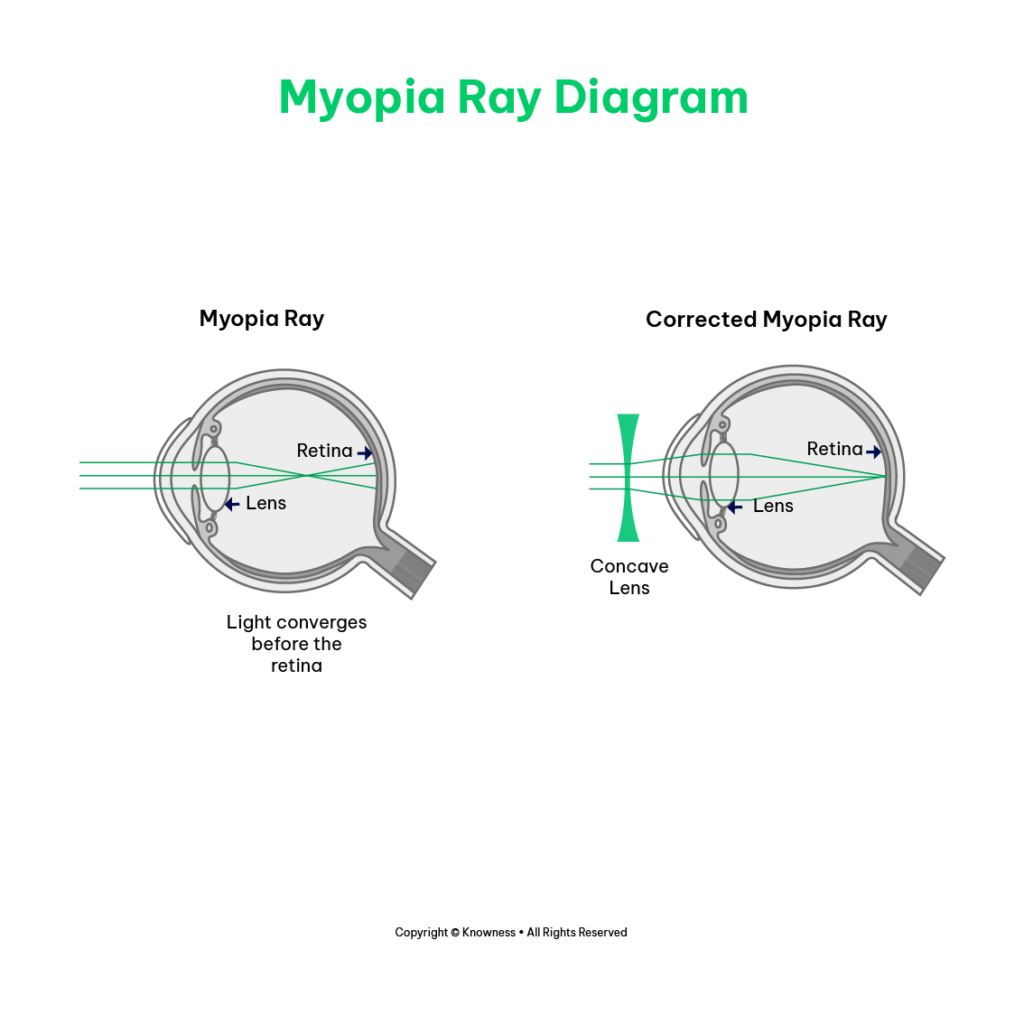
Spectacle Lens Correction for Myopia:
- Concave lenses are used to correct myopia.
- Concave lenses diverge incoming light rays, causing them to appear as if they are coming from a farther distance.
- By diverging the light before it enters the eye, the lens helps to move the focal point back onto the retina, resulting in clear vision.
Hyperopia (Long-sightedness)
Hyperopia is a condition in which the eye's focal point is behind the retina, causing nearby objects to appear blurry.
Ray Diagram for Hyperopia:
- Incoming parallel rays of light from a nearby object converge behind the retina.
- The image formed on the retina is therefore blurry.
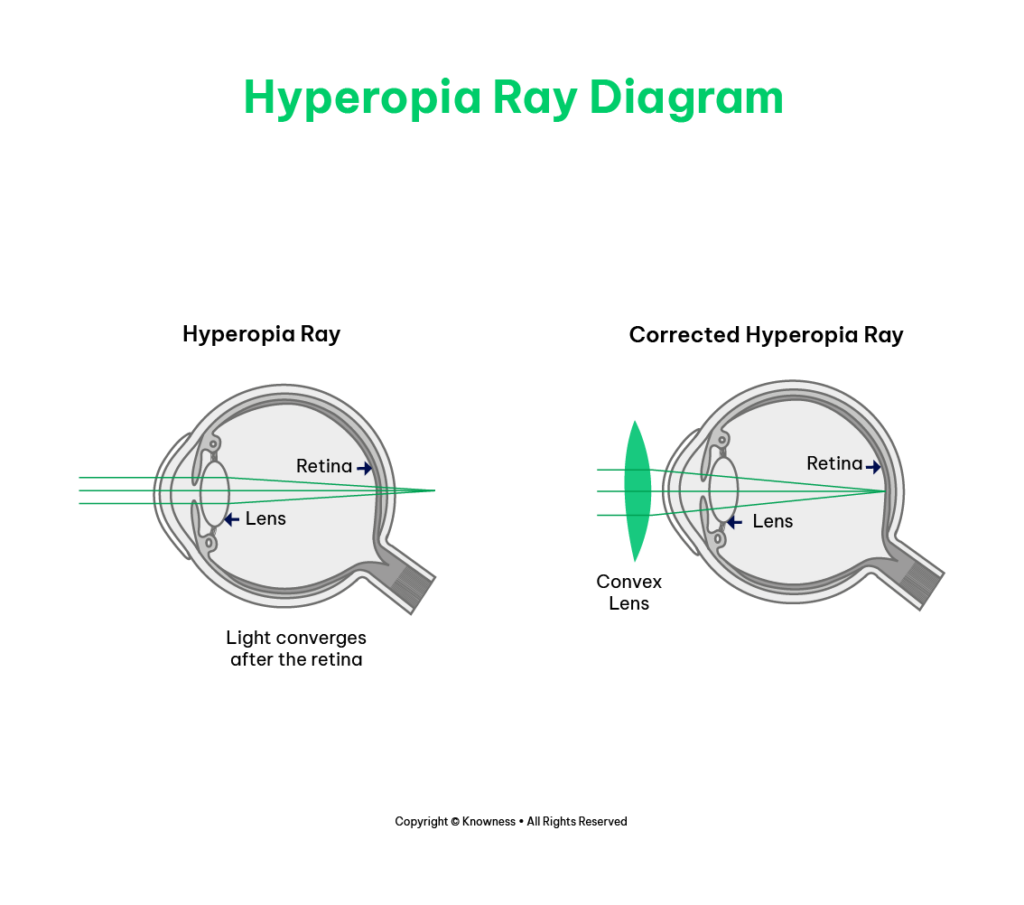
Spectacle Lens Correction for Hyperopia:
- Convex lenses are used to correct hyperopia.
- Convex lenses converge incoming light rays, bringing the focal point forward and onto the retina.
- By converging the light before it reaches the eye, the lens helps to focus the image directly on the retina, resulting in clear vision.
Conclusion
The eye is a complex organ with various structures working together to enable vision. Understanding the structures and functions of the eye, including accommodation and adaptation to light, helps us appreciate its remarkable capabilities. Additionally, recognising common eye defects, such as myopia and hyperopia, and their treatments emphasises the importance of vision care and the advancements in correcting refractive errors.
Continue the lesson
This section is available to learners with course access. Continue learning with Knowness to unlock the full explanation, examples, revision tools, and progress tracking.
The remaining lesson content includes further guided explanation, important learning points, and supporting interactive material designed to help you understand and revise this topic.
Unlock this topic to view the full activity, worked examples, common mistakes, and additional revision support.
More content available
Knowness lessons are structured to build understanding step by step. Create an account or upgrade your access to continue from this point.
This preview does not include the hidden lesson text, answers, explanations, or embedded interactions.
Continue learning with Knowness
Sign up to access the full lesson, predicted grades, revision tools, progress tracking, and more.
Create a free account