

GCSE
Biology
-
Introduction to GCSE Biology (AQA) Coming soon
-
1.1 Cell Structure
-
1.2 Cell Division Coming soon
-
1.3 Transport in Cells Coming soon
-
2.1 Principles of Organisation Coming soon
-
2.2 Animal Tissues, Organs and Organ Systems Coming soon
-
2.3 Plant Tissues, Organs and Systems Coming soon
-
3.1 Communicable Diseases Coming soon
-
3.2 Monoclonal Antibodies [HT] Coming soon
-
3.3 Plant Disease Coming soon
-
4.1 Photosynthesis Coming soon
-
4.2 Respiration Coming soon
-
5.1 Homeostasis Coming soon
-
5.2 The Human Nervous System Coming soon
-
5.3 Hormonal Coordination in Humans Coming soon
-
5.4 Plant Hormones Coming soon
-
6.1 Reproduction Coming soon
-
6.2 Variation and Evolution Coming soon
-
6.3 The Development of Understanding of Genetics and Evolution Coming soon
-
6.4 Classification of Living Organisms Coming soon
-
7.1 Adaptations, Interdependence and Competition Coming soon
-
7.2 Organisation of an Ecosystem Coming soon
-
7.3 Biodiversity and the Effect of Human Interaction on Ecosystems Coming soon
-
7.4 Trophic Levels in an Ecosystem Coming soon
-
7.5 Food Production Coming soon
1. Cell Biology
4.1.1 Photosynthetic Reaction
In this lesson, we will explore the photosynthetic reaction and the chemical symbols associated with it. We will also explore photosynthesisThe process by which plants use light energy to produce glucose. as an endothermicA reaction that ‘absorbs’ heat, where the products have greater energy than the reactants. process involving the transfer of energy from the environment to the chloroplasts.
Photosynthesis
Photosynthesis is the process by which plants and some other organisms convert light energy from the sun into chemical energy in the form of glucose.
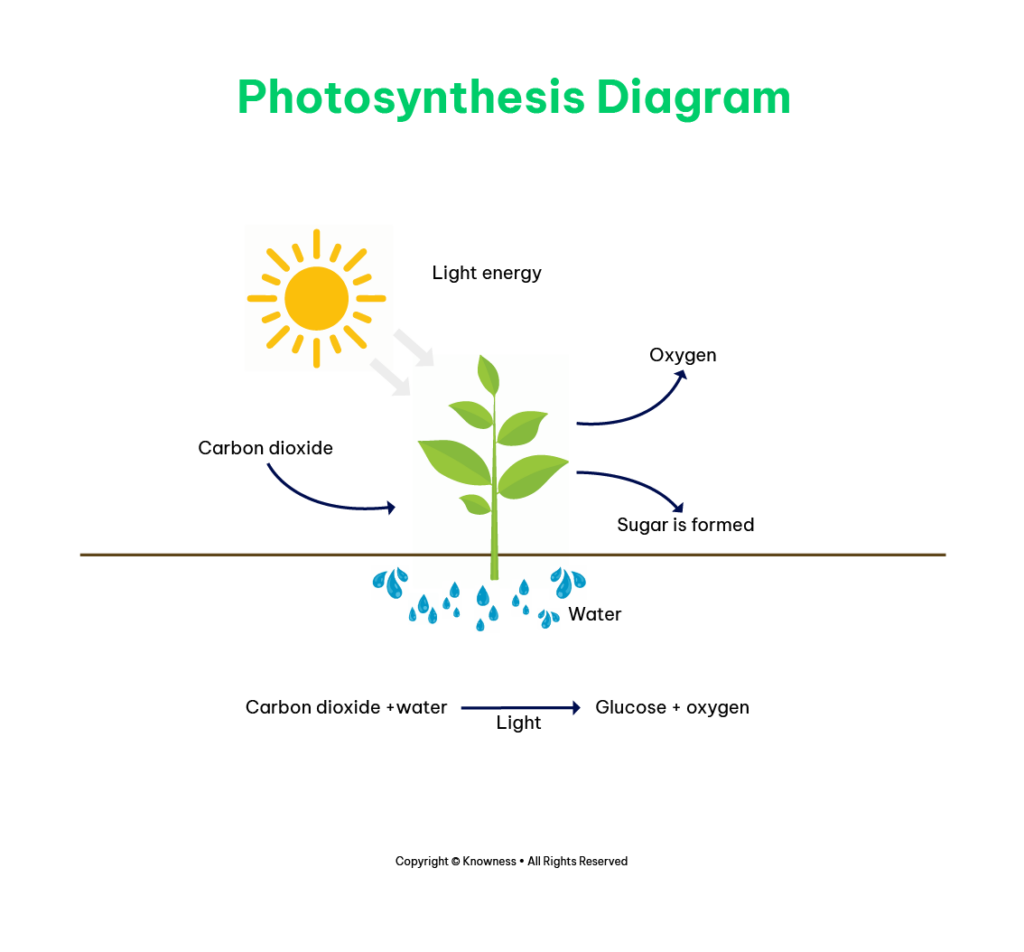
The photosynthetic reaction can be represented by the following equation:
carbon dioxide + water –light–> glucose + oxygen
6CO2 + 6H2O + light energy → C6H12O6 + 6O2
Reactants:
- Carbon Dioxide (CO2)
- A gas that enters plant leaves through tiny pores called stomata.
- It is obtained from the atmosphere during the process of gas exchange.
- Water (H2O)
- Obtained from the soil through the roots of the plant.
- Transported to the leaves via xylemPlant tissue that transports water and mineral ions from roots to the rest of the plant. vessels.
- Light Energy
- Absorbed by pigments, such as chlorophyllA green pigment found in chloroplasts that absorbs light energy for photosynthesis., located in the chloroplasts of plant cells.
- Light energy is a crucial component that drives the photosynthetic process.
Products:
- Glucose (C6H12O6)
- A simple sugar molecule that serves as the primary energy source for plants.
- It can be used immediately for energy or converted into other organic compounds for storage.
- Oxygen (O2)
- A byproduct of photosynthesis released into the atmosphere.
- Oxygen is crucial for the survival of organisms that undergo respiration.
Photosynthesis as an Endothermic Reaction
An endothermic reaction is a chemical reaction that requires or absorbs energy from its surroundings. In photosynthesis, energy is absorbed from the environment and utilised in the synthesisCombining information from more than one text to show comparison. of glucose.
Role of Light Energy:
- Light energy is the primary source of energy in photosynthesis.
- Chlorophyll pigments, located in the chloroplasts of plant cells, absorb light energy.
- The absorbed light energy is used to power the photosynthetic process.
Energy Transfer:
- Light energy is absorbed by chlorophyll pigments in the chloroplasts.
- This energy is then transferred to the reactants, carbon dioxide (CO2) and water (H2O), within the chloroplasts.
- The energy transfer initiates a series of chemical reactions that ultimately result in the production of glucose (C6H12O6) and oxygen (O2).
Endothermic Nature of Photosynthesis:
- The absorption of light energy by chlorophyll pigments is an endothermic process.
- The energy absorbed from the environment is utilised to convert carbon dioxide and water into glucose.
- This energy transfer is essential for the synthesis of glucose, which stores chemical energy in plants.
Importance of Energy Transfer in Photosynthesis
Storage of Chemical Energy:
- Glucose, produced during photosynthesis, acts as a primary energy source for plants.
- The chemical energy stored in glucose is used for various metabolic processes within the plant.
Oxygen Production:
- As a byproduct of photosynthesis, oxygen is released into the atmosphere.
- Oxygen is vital for aerobic respirationA chemical process that releases energy from glucose using oxygen, occurring in mitochondria. in both plants and animals.
Conclusion
Photosynthesis is a vital process that allows plants to convert light energy into chemical energy in the form of glucose. The photosynthetic equation demonstrates the inputs and outputs of this energy-transforming process. Photosynthesis is an endothermic process in which energy is transferred from the environment to the chloroplasts of plant cells. The absorption of light energy by chlorophyll pigments initiates the photosynthetic reaction, enabling the synthesis of glucose and the production of oxygen.
Continue the lesson
This section is available to learners with course access. Continue learning with Knowness to unlock the full explanation, examples, revision tools, and progress tracking.
The remaining lesson content includes further guided explanation, important learning points, and supporting interactive material designed to help you understand and revise this topic.
Unlock this topic to view the full activity, worked examples, common mistakes, and additional revision support.
More content available
Knowness lessons are structured to build understanding step by step. Create an account or upgrade your access to continue from this point.
This preview does not include the hidden lesson text, answers, explanations, or embedded interactions.
Continue learning with Knowness
Sign up to access the full lesson, predicted grades, revision tools, progress tracking, and more.
Create a free account