

GCSE
Biology
-
Introduction to GCSE Biology (AQA) Coming soon
-
1.1 Cell Structure
-
1.2 Cell Division Coming soon
-
1.3 Transport in Cells Coming soon
-
2.1 Principles of Organisation Coming soon
-
2.2 Animal Tissues, Organs and Organ Systems Coming soon
-
2.3 Plant Tissues, Organs and Systems Coming soon
-
3.1 Communicable Diseases Coming soon
-
3.2 Monoclonal Antibodies [HT] Coming soon
-
3.3 Plant Disease Coming soon
-
4.1 Photosynthesis Coming soon
-
4.2 Respiration Coming soon
-
5.1 Homeostasis Coming soon
-
5.2 The Human Nervous System Coming soon
-
5.3 Hormonal Coordination in Humans Coming soon
-
5.4 Plant Hormones Coming soon
-
6.1 Reproduction Coming soon
-
6.2 Variation and Evolution Coming soon
-
6.3 The Development of Understanding of Genetics and Evolution Coming soon
-
6.4 Classification of Living Organisms Coming soon
-
7.1 Adaptations, Interdependence and Competition Coming soon
-
7.2 Organisation of an Ecosystem Coming soon
-
7.3 Biodiversity and the Effect of Human Interaction on Ecosystems Coming soon
-
7.4 Trophic Levels in an Ecosystem Coming soon
-
7.5 Food Production Coming soon
1. Cell Biology
2.3.2 Plant Organ System
In this lesson, we will explore the structureThe organisation and order of information in a text. and function of various plant organA structure made of different tissues working together to perform a specific function. systems. We will focusWhat the writer draws attention to at a given moment (e.g., setting, character, detail). on the roots, stem, and leaves and their roles in processes such as transpiration, translocation, and gas exchange. Additionally, we will learn how to measure transpiration rates and investigate stomata distribution.
Plant Organ SystemA group of organs working together to carry out a major body function. for Transport
- Roots: Responsible for water and mineral uptake from the soil.
- Stem: Acts as a conduit for water and nutrients between the roots and leaves.
- Leaves: Facilitate gas exchange and serve as the primary site for photosynthesisThe process by which plants use light energy to produce glucose..
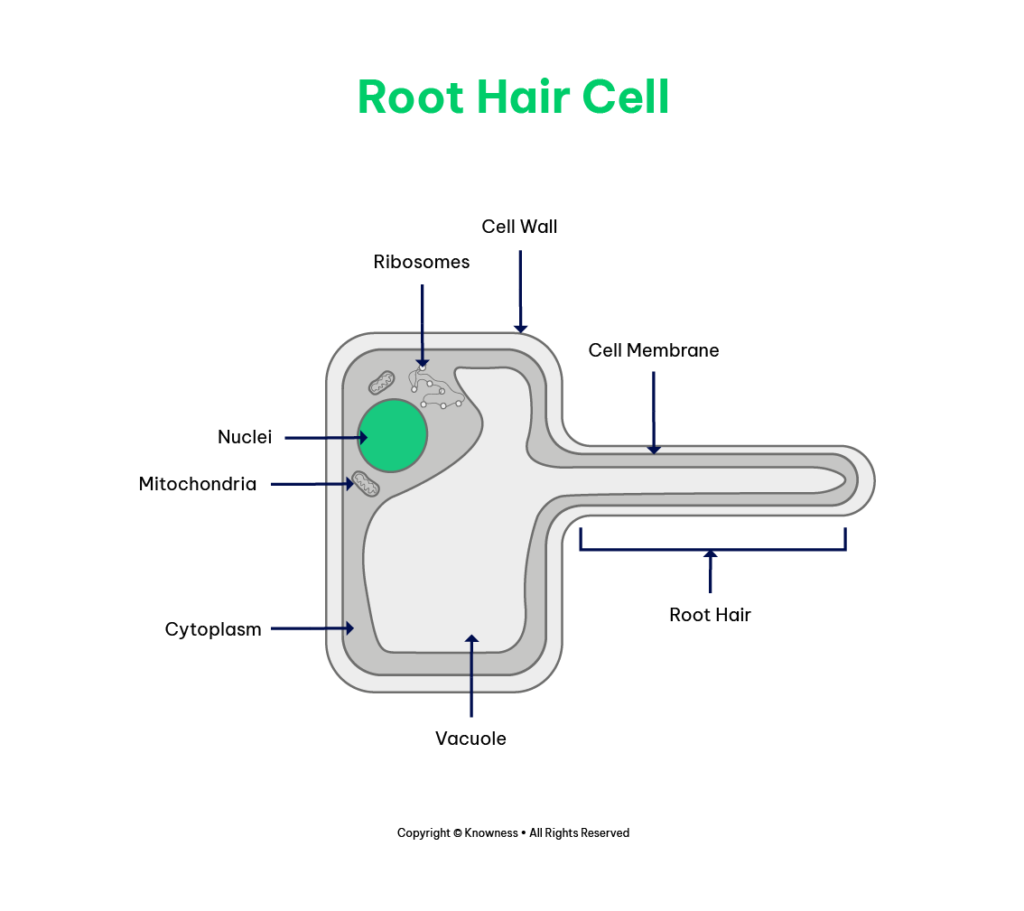
Root Hair Cells
Root hair cells have thin, elongated projections on root surfaces that increase surface area for efficient water and mineral ion uptake. The large surface area of root hairs enhances the absorption from the soil of water by osmosisThe movement of water across a partially permeable membrane from a dilute solution to a more concentrated solution. and mineral ions by active transportThe movement of substances against a concentration gradient using energy from respiration..
XylemPlant tissue that transports water and mineral ions from roots to the rest of the plant. and PhloemPlant tissue that transports dissolved sugars around the plant.
Xylem tissueA group of similar specialised cells working together to perform a function. is composed of tracheids and vessel elements, which are elongated, hollow cells. These cells are interconnected and form continuous tubes. Water is transported from roots to stems and leaves through xylem vessels in a process called the transpiration stream.
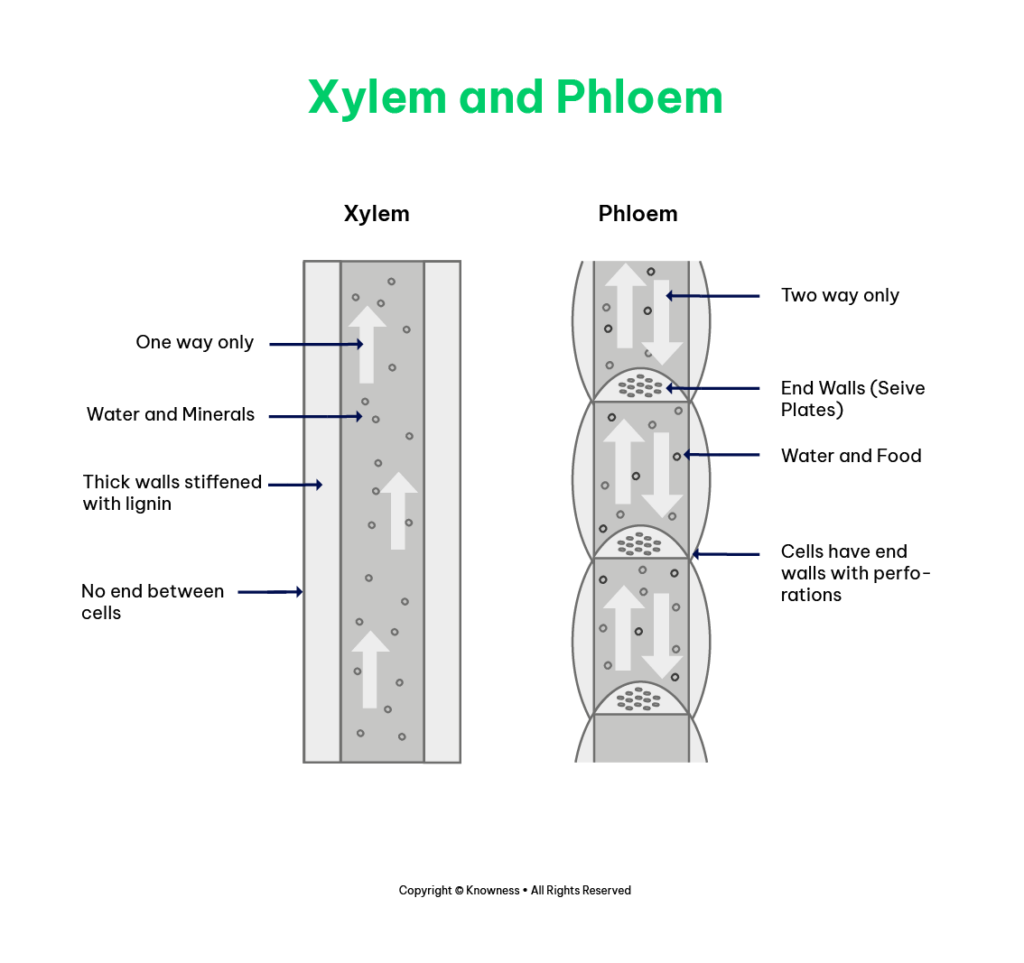
Phloem consists of sieve tube elements and companion cells. Sieve tube elements have perforated end walls called sieve plates. Phloem transports sugars, amino acids, and other organic nutrients throughout the plant. The presence of sieve plates allows for the efficient movement of nutrients between cells.
Transpiration
Transpiration is the process by which water is lost from plant tissues through stomata in the leaves. Stomata are structures on leaf surfaces that regulate gas exchange and water loss.
- Structure of Stomata: Composed of two guard cells surrounding a stomatal pore.
- Function of Stomata: Control the opening and closing of the pore to regulate transpiration and gas exchange.
Translocation
Translocation is the movement of sugars and other organic compounds through phloem tissue. Phloem Tissue is composed of elongated cells called sieve tubes and companion cells.
- Structure of Phloem Tissue: Sieve tubes contain pores in their end walls for the movement of cell sapA weak solution of sugars and salts found in the vacuole of plant cells..
- Function of Phloem Tissue: Transport dissolved sugars from leaves to other parts of the plant.
Factors Affecting Transpiration Rate
- Temperature: Higher temperatures generally increase transpiration rates due to increased evaporation and water vapour saturation deficit.
- Humidity: Lower humidity levels result in higher transpiration rates, as the water potential gradient between the plant and the surrounding air increases.
- Air Movement: Increased air movement around leaves promotes transpiration by removing the water vapour boundary layerArea of fluid closest to the wall within a pipe/solid surface where the fluid behaves differently to the bulk fluid. from the leaf surface.
- Light Intensity: Higher light intensity leads to increased transpiration rates due to stomatal opening for photosynthesis.
Measuring Transpiration Rate
- Uptake of Water: One methodHow a writer presents perspective or viewpoint through language/structure. to measure transpiration rate is by monitoring the uptake of water by a potted plant over a specific time period. This can be achieved using a potometer, a device that measures the movement of water into the plant.
- Change in Mass: Another method is to measure the change in mass of a potted plant over time. By weighing the plant at regular intervals, the loss of water through transpiration can be quantified.
Transpiration rate can be determined by dividing the amount of water lost through transpiration by the time taken.
Importance of Measuring Transpiration Rate:
- Assessing Plant Health: Monitoring transpiration rate helps determine plant health and water requirements. Reduced transpiration may indicate plant stress or inadequate water uptake.
- Investigating Environmental Factors: Measuring transpiration rate allows us to study the impact of different environmental factors on plant water loss and adaptability.
Application of Transpiration Rate Measurement:
- Research and Crop Yield: Understanding transpiration rates aids in the development of irrigation strategies and the improvement of crop yields.
- Plant Physiology and Biology: Measuring transpiration rate contributes to our understanding of plant physiology and the functioning of plant organ systems.
Key Functions and Adaptations of Plant Organ System
- Stomata and Guard Cells: Stomata regulate gas exchange and control water loss by opening and closing the stomatal pore. Guard cells change shape to control the opening and closing of stomata, influenced by factors such as light, temperature, and humidity.
- Phloem Tissue and Translocation: Phloem tissue transports dissolved sugars and other organic compounds throughout the plant for immediate use or storage. The movement of cell sap through phloem is facilitated by pores in the end walls of sieve tube cells.
Conclusion
Plant organ systems, including root hair cells, xylem, phloem, and stomata, have specific structures that are adapted to their functions. Root hair cells maximise water and mineral absorption, while xylem and phloem transport substances throughout the plant. Transpiration, facilitated by stomata and controlled by guard cells, enables water movement from roots to leaves, and can be measured to understand water loss in plants. Translocation occurs through phloem tissue, transporting sugars to various plant parts. Root hair cells and xylem tissue play essential roles in efficient water and mineral ion uptake.
Continue the lesson
This section is available to learners with course access. Continue learning with Knowness to unlock the full explanation, examples, revision tools, and progress tracking.
The remaining lesson content includes further guided explanation, important learning points, and supporting interactive material designed to help you understand and revise this topic.
Unlock this topic to view the full activity, worked examples, common mistakes, and additional revision support.
More content available
Knowness lessons are structured to build understanding step by step. Create an account or upgrade your access to continue from this point.
This preview does not include the hidden lesson text, answers, explanations, or embedded interactions.
Continue learning with Knowness
Sign up to access the full lesson, predicted grades, revision tools, progress tracking, and more.
Create a free account