

GCSE
Biology
-
Introduction to GCSE Biology (AQA) Coming soon
-
1.1 Cell Structure
-
1.2 Cell Division Coming soon
-
1.3 Transport in Cells Coming soon
-
2.1 Principles of Organisation Coming soon
-
2.2 Animal Tissues, Organs and Organ Systems Coming soon
-
2.3 Plant Tissues, Organs and Systems Coming soon
-
3.1 Communicable Diseases Coming soon
-
3.2 Monoclonal Antibodies [HT] Coming soon
-
3.3 Plant Disease Coming soon
-
4.1 Photosynthesis Coming soon
-
4.2 Respiration Coming soon
-
5.1 Homeostasis Coming soon
-
5.2 The Human Nervous System Coming soon
-
5.3 Hormonal Coordination in Humans Coming soon
-
5.4 Plant Hormones Coming soon
-
6.1 Reproduction Coming soon
-
6.2 Variation and Evolution Coming soon
-
6.3 The Development of Understanding of Genetics and Evolution Coming soon
-
6.4 Classification of Living Organisms Coming soon
-
7.1 Adaptations, Interdependence and Competition Coming soon
-
7.2 Organisation of an Ecosystem Coming soon
-
7.3 Biodiversity and the Effect of Human Interaction on Ecosystems Coming soon
-
7.4 Trophic Levels in an Ecosystem Coming soon
-
7.5 Food Production Coming soon
1. Cell Biology
2.3.1 Plant Tissues
In this lesson, we will explore the different types of plant tissues and their respective structures and functions. Plant tissues are specialised groups of cells that work together to carry out specific functions in plants.
Plant Tissues
Plant tissues encompass a diverse array of specialised structures that collectively contribute to the form, function, and growth of plants.
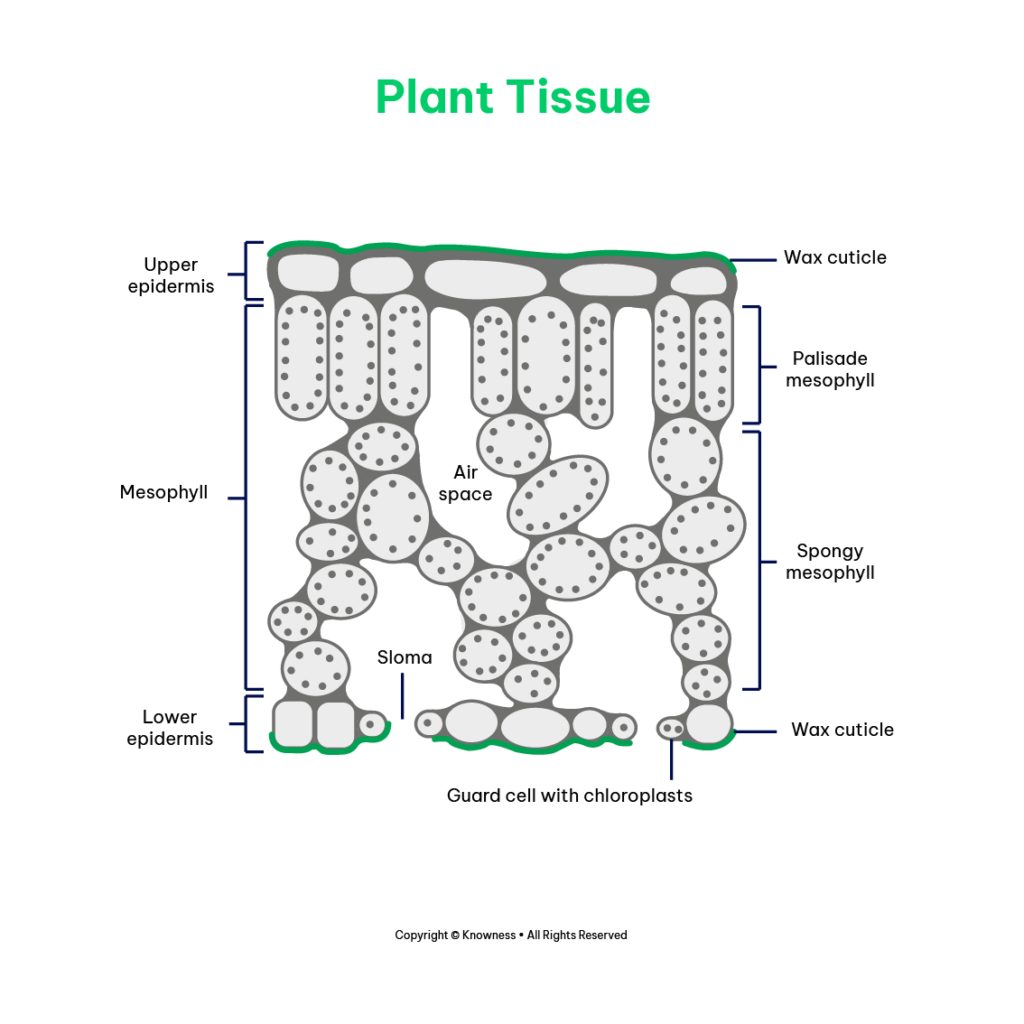
These tissues include epidermal tissues, which form the protective outer layer of plant organs; palisade mesophyll, responsible for photosynthesisThe process by which plants use light energy to produce glucose. due to its densely packed chloroplasts; spongy mesophyll, which aids in gas exchange and stores vital nutrients; xylemPlant tissue that transports water and mineral ions from roots to the rest of the plant. and phloemPlant tissue that transports dissolved sugars around the plant., the vascular tissues that transport water, minerals, and nutrients throughout the plant; and meristemA region in plants containing unspecialised cells that can divide and differentiate throughout the plant’s life. tissueA group of similar specialised cells working together to perform a function., found at the growing tips of shoots and roots, where continuous cell division occurs, driving the plant's growth and development.
Epidermal Tissues:
- StructureThe organisation and order of information in a text.: Epidermal tissues form the outermost layer of plant organs, such as leaves, stems, and roots. They consist of a single layer of cells that are tightly packed together, forming a protective barrier.
- Function: The epidermis acts as a protective layer, preventing excessive water loss and serving as a barrier against pathogens and environmental stresses. In leaves, the epidermis also contains specialised cells called guard cells that control the opening and closing of stomata, regulating gas exchange and water loss.
Palisade Mesophyll:
- Structure: Palisade mesophyll is a layer of closely packed, elongated cells located beneath the upper epidermis of leaves. These cells contain numerous chloroplasts for photosynthesis.
- Function: Palisade mesophyll is responsible for the majority of photosynthesis in leaves, converting light energy into chemical energy.
Spongy Mesophyll:
- Structure: Spongy mesophyll is located beneath the palisade mesophyll, towards the lower epidermis of leaves. It consists of loosely arranged cells with air spaces in between.
- Function: Spongy mesophyll facilitates gas exchange and diffusion of gases, allowing for the exchange of carbon dioxide and oxygen between the leaf and the external environment.
Xylem:
- Structure: Xylem tissue consists of specialised cells called tracheids and vessel elements, which are elongated cells with thickened walls. These cells are interconnected to form continuous tubes.
- Function: Xylem is responsible for the transport of water and minerals from the roots to the rest of the plant. It also provides structural support to the plant.
Phloem:
- Structure: Phloem tissue consists of sieve tube elements and companion cells. Sieve tube elements are elongated cells with perforated end walls called sieve plates.
- Function: Phloem transports organic nutrients, such as sugars and amino acids, from the leaves (source) to other parts of the plant (sink). Companion cells provide metabolic support to sieve tube elements.
Meristem Tissue:
- Structure: Meristem tissue is found at the growing tips of shoots and roots. It consists of undifferentiated cells that continuously divide, allowing for growth and development.
- Function: Meristem tissue is responsible for primary and secondary growth in plants. It gives rise to various specialised cells and tissues, allowing plants to increase in height and girth.
Conclusion
Plant tissues, such as epidermal, mesophyll, vascular, and meristem tissues, are integral to the structure and function of plants. Epidermal tissues protect plants from external factors, while mesophyll tissues facilitate photosynthesis and gas exchange. Vascular tissues, including xylem and phloem, transport water, minerals, and nutrients throughout the plant. Meristem tissues enable growth and development in plants.
Continue the lesson
This section is available to learners with course access. Continue learning with Knowness to unlock the full explanation, examples, revision tools, and progress tracking.
The remaining lesson content includes further guided explanation, important learning points, and supporting interactive material designed to help you understand and revise this topic.
Unlock this topic to view the full activity, worked examples, common mistakes, and additional revision support.
More content available
Knowness lessons are structured to build understanding step by step. Create an account or upgrade your access to continue from this point.
This preview does not include the hidden lesson text, answers, explanations, or embedded interactions.
Continue learning with Knowness
Sign up to access the full lesson, predicted grades, revision tools, progress tracking, and more.
Create a free account