

GCSE
Biology
-
Introduction to GCSE Biology (AQA) Coming soon
-
1.1 Cell Structure
-
1.2 Cell Division Coming soon
-
1.3 Transport in Cells Coming soon
-
2.1 Principles of Organisation Coming soon
-
2.2 Animal Tissues, Organs and Organ Systems Coming soon
-
2.3 Plant Tissues, Organs and Systems Coming soon
-
3.1 Communicable Diseases Coming soon
-
3.2 Monoclonal Antibodies [HT] Coming soon
-
3.3 Plant Disease Coming soon
-
4.1 Photosynthesis Coming soon
-
4.2 Respiration Coming soon
-
5.1 Homeostasis Coming soon
-
5.2 The Human Nervous System Coming soon
-
5.3 Hormonal Coordination in Humans Coming soon
-
5.4 Plant Hormones Coming soon
-
6.1 Reproduction Coming soon
-
6.2 Variation and Evolution Coming soon
-
6.3 The Development of Understanding of Genetics and Evolution Coming soon
-
6.4 Classification of Living Organisms Coming soon
-
7.1 Adaptations, Interdependence and Competition Coming soon
-
7.2 Organisation of an Ecosystem Coming soon
-
7.3 Biodiversity and the Effect of Human Interaction on Ecosystems Coming soon
-
7.4 Trophic Levels in an Ecosystem Coming soon
-
7.5 Food Production Coming soon
1. Cell Biology
2.2.1 The Human Digestive System
In this lesson, we will explore the intricate workings of the human digestive system, an organ systemA group of organs working together to carry out a major body function. where several organs collaborate to digest and absorb food.
The Human Digestive System
The human digestive system is an organA structure made of different tissues working together to perform a specific function. system responsible for the breakdown, digestion, and absorption of food. It involves the coordinated functioning of several organs, including the mouth, oesophagus, stomach, small intestine, and large intestine.
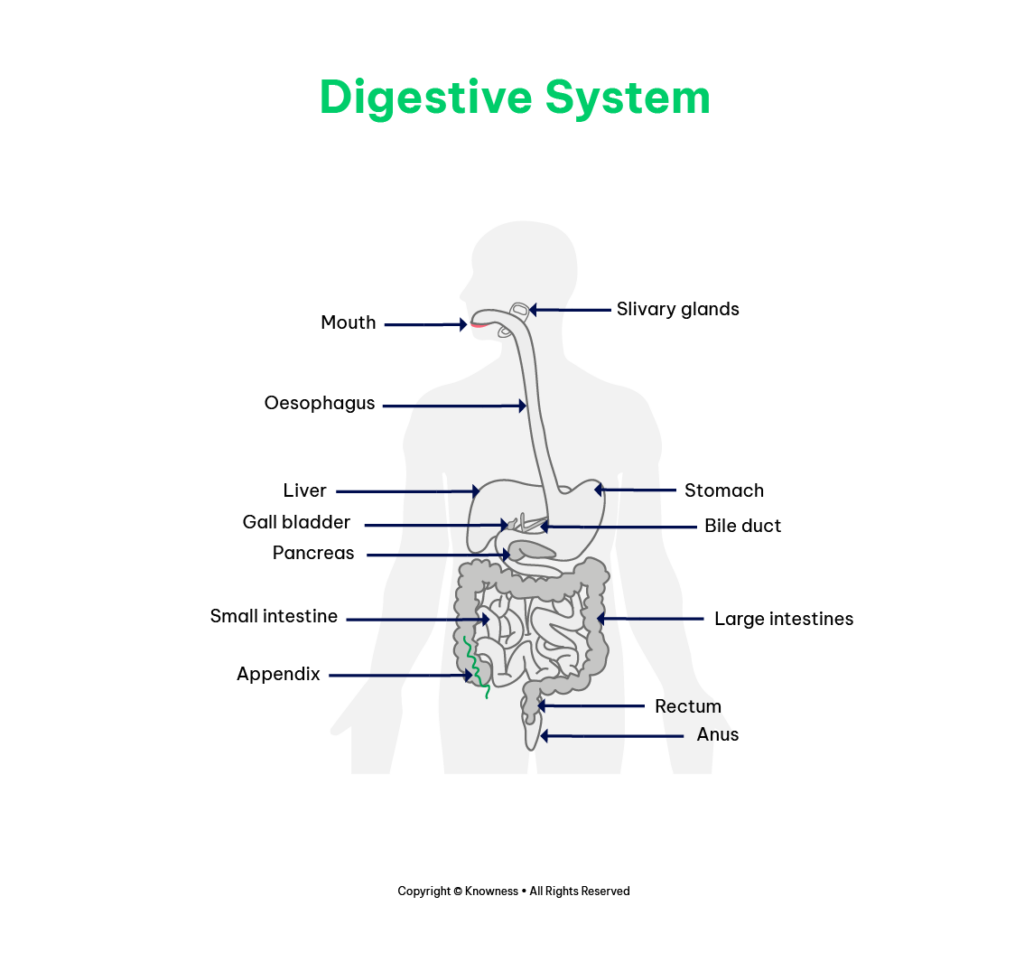
Digestion refers to the mechanical and chemical breakdown of food into smaller molecules that can be absorbed by the body. Absorption involves the uptake of these smaller molecules from the digestive tract into the bloodstream for distribution to cells and tissues.
Enzymes and MetabolismChemical reactions within a cell allowing microorganisms to maintain themselves and multiply.
Enzymes are specialised protein molecules that act as catalysts in biological reactions. They facilitate the breakdown of complex molecules into simpler ones during digestion.
Enzymes play a crucial role in metabolism, which refers to the sum of all chemical reactions in an organism. Metabolic reactions involve the breakdown and synthesisCombining information from more than one text to show comparison. of molecules necessary for energy production, growth, and maintenance.
EnzymeA biological catalyst that speeds up chemical reactions in cells. Activity and Temperature
Enzymes have an optimal temperature at which they exhibit maximum activity. As the temperature deviates from the optimal range, enzyme activity may decrease or denature.
Higher temperatures can increase enzyme activity, but excessive heat can lead to denaturation. Lower temperatures can decrease enzyme activity, limiting the rate of metabolic reactions.
Enzyme Activity and pH Changes
Enzymes have an optimal pH at which they function most efficiently. Deviations from the optimal pH can affect the enzyme's structureThe organisation and order of information in a text. and, consequently, its activity.
Changes in pH can alter the charges and shape of enzyme molecules, affecting their ability to bind to substrates and catalyse reactions. Different enzymes have different pH optima based on their specific functions and the environment they operate in.
Enzymes and Active Sites
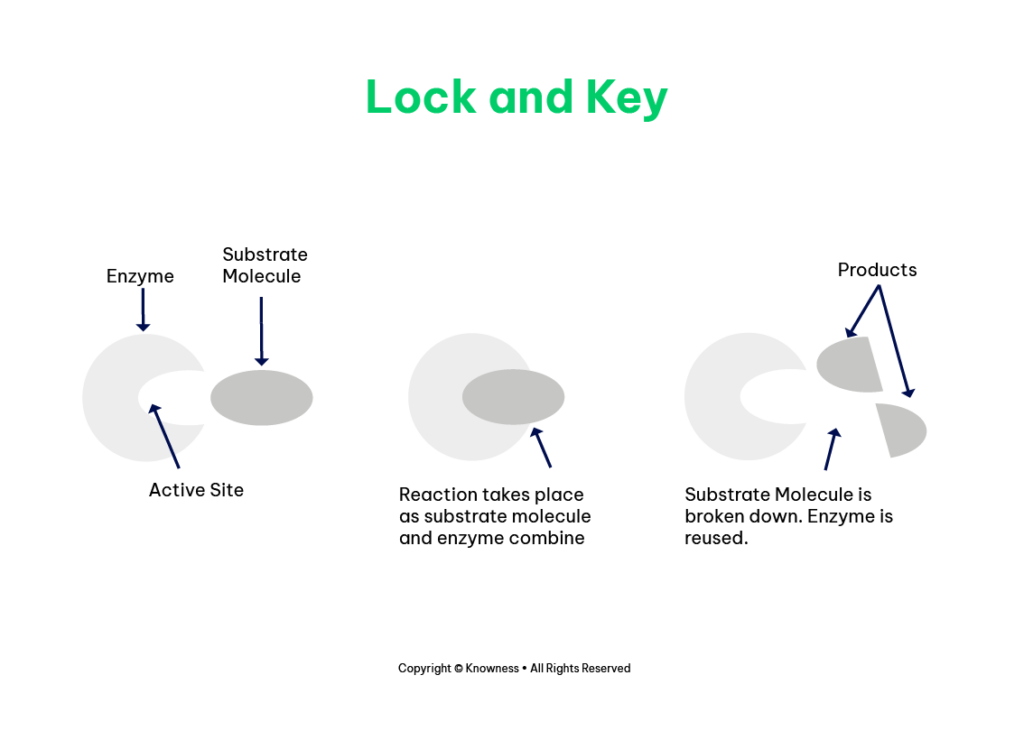
Enzymes are biological catalysts that speed up chemical reactions in living organisms. They are specific in nature and catalyse specific reactions due to the shape of their active site.
Enzymes have a unique three-dimensional shape, which includes an active site. The active site is the region where the substrate, the molecule upon which the enzyme acts, binds and undergoes a chemical reaction.
Enzymatic Reactions in the Digestive System
The human digestive system relies on a variety of enzymes to break down complex macromolecules into smaller, more easily absorbed molecules.
Specific enzymes are responsible for the breakdown of carbohydrates, proteins, and lipids into their respective monomers. For example, amylase breaks down starch into simple sugars, while pepsin digests proteins into smaller peptides.
Importance of Enzyme Activity in Digestion:
- Efficiency of Digestive Processes: Enzymes significantly accelerate the breakdown of macromolecules, facilitating digestion and nutrient absorption. Without enzymes, the digestion process would be considerably slower and less efficient.
- Enzyme Regulation: Enzyme activity can be regulated by various factors, such as pH, temperature, and the presence of inhibitors or activators. These factors influence the shape and activity of the enzyme, affecting the rate of digestion.
Rate Calculations for Enzymatic Reactions
Reaction rate refers to the speed at which a chemical reaction occurs, measured by the change in concentration of a reactant or product per unit time.
The rate of a reaction can be calculated using the formula:
Rate = ΔC / Δt
where ΔC represents the change in concentration and Δt represents the change in time.
Rate calculations can be applied to measure the rate of enzyme-catalysed reactions involved in digestion. For example, the rate of carbohydrate digestion can be determined by measuring the decrease in starch concentration over a specific time period.
Lock and Key Theory
The lock and key theory is a simplified model used to explain enzyme action. According to this theory, enzymes have a specific shape (key) that fits the substrate's shape (lock), allowing them to interact and catalyse chemical reactions.
Digestive Enzymes
Digestive enzymes convert complex food molecules into smaller, soluble molecules that can be absorbed into the bloodstream. They play a crucial role in breaking down carbohydrates, proteins, and lipids for absorption and utilisation by the body.
Amylase:
- Site of Production: Salivary glands (salivary amylase) and pancreas (pancreatic amylase).
- Action: Amylase breaks down starch (complex carbohydrates) into simple sugars (e.g., glucose).
Proteases:
- Site of Production: Stomach (pepsin), pancreas (trypsin, chymotrypsin), and small intestine (peptidases).
- Action: Proteases break down proteins into amino acids, which can be absorbed and used by the body.
Lipases:
- Site of Production: Pancreas (pancreatic lipase) and small intestine (intestinal lipases).
- Action: Lipases break down lipids (fats) into glycerol and fatty acids, facilitating their absorption.
The Role of Digestion Products
The products of digestion are used to build new carbohydrates, lipids, and proteins in the body. Glucose, a product of carbohydrate digestion, is used as a source of energy in cellular respiration.
Bile
Bile is produced in the liver and stored in the gallbladder. It is released into the small intestine when needed for fat digestion.
Functions of Bile:
- Alkaline Nature: Bile is alkaline to neutralise the acidic environment created by hydrochloric acid in the stomach, providing an optimal pH for enzyme activity in the small intestine.
- Emulsification of Fat: Bile emulsifies fats, breaking them down into small droplets and increasing the surface area for efficient digestion by lipases.
Conclusion
The human digestive system exemplifies the remarkable coordination of organs in an organ system. Through the collaborative efforts of various organs, food is broken down, digested, and absorbed to provide nutrients for the body's metabolic processes. Enzymes play a crucial role in digestion and metabolism, facilitating the breakdown of complex molecules. Their unique shape and active site allow for the binding and efficient breakdown of macromolecules into smaller, more manageable components. Through the lock and key theory, enzymes catalyse the breakdown of complex food molecules into smaller, absorbable substances.
Continue the lesson
This section is available to learners with course access. Continue learning with Knowness to unlock the full explanation, examples, revision tools, and progress tracking.
The remaining lesson content includes further guided explanation, important learning points, and supporting interactive material designed to help you understand and revise this topic.
Unlock this topic to view the full activity, worked examples, common mistakes, and additional revision support.
More content available
Knowness lessons are structured to build understanding step by step. Create an account or upgrade your access to continue from this point.
This preview does not include the hidden lesson text, answers, explanations, or embedded interactions.
Continue learning with Knowness
Sign up to access the full lesson, predicted grades, revision tools, progress tracking, and more.
Create a free account