

1.1.5 Culturing Microorganisms
In this lesson, you will learn how microorganisms are cultured in the laboratory. You will explore how bacteriaA single-celled prokaryotic microorganism. reproduce by binary fissionAsexual reproduction in bacteria where one cell divides into two genetically identical daughter cells. and how they are grown in nutrient broth or on agarA jelly-like substance made from seaweed that is used as a solid growth medium for culturing microorganisms. plates. You will also examine aseptic techniques used to prevent contamination and ensure safe practice in school laboratories, and practise calculating the cross-sectional area of bacterial colonies and estimating bacterial population growth using standard formA way of writing very large or very small numbers as a number between 1 and 10 multiplied by a power of ten..
Culturing Microorganisms
Culturing microorganisms allows scientists to investigate how bacteria grow, reproduce and respond to different conditions such as antibiotics or disinfectants. In school laboratories, only non-pathogenic bacteria are used and strict safety procedures are followed. Non-pathogenic bacteria are those that are not capable of causing disease, whereas pathogenic microorganisms are those that can cause disease.
When bacteria are cultured under suitable conditions, they reproduce rapidly through a process known as binary fission, which we will explore next.
Binary Fission
Bacteria reproduce asexually by a process called binary fission. Asexual reproduction involves only one parent, with no fusion of sex cells, and produces genetically identical offspring called clones; this is covered in Module 6.1 Reproduction.
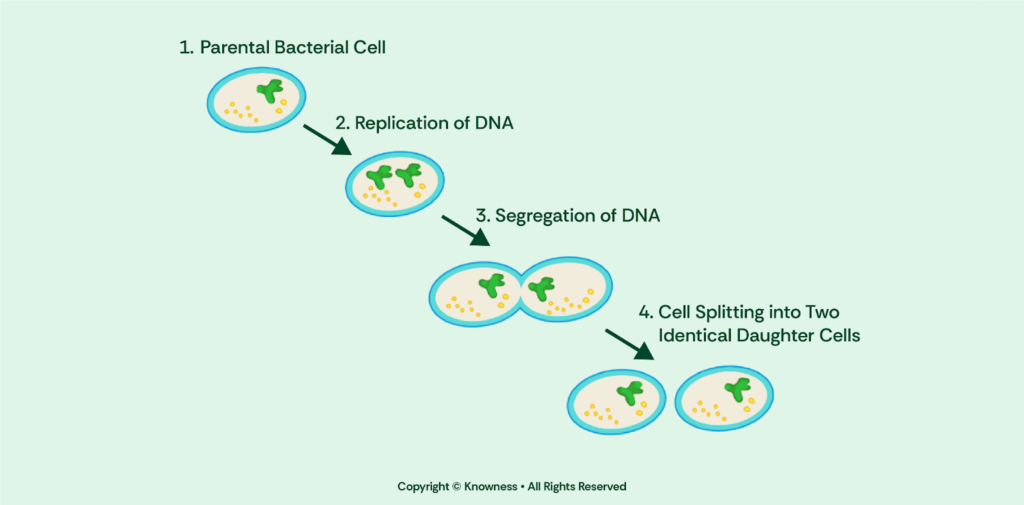
During binary fission, the bacterial DNA replicates and the cell divides into two genetically identical daughter cellsThe two new cells formed after cell division.. The steps for binary fission are shown in Figure 1 above and are as follows:
- Parental Bacterial Cell: The process begins with one bacterial cell. Inside the cell is a circular loop of DNA, which contains the genetic information needed for the cell to function and reproduce.
- Replication of DNA: The bacterial DNA is copied (replicated). Now the cell contains two identical copies of its DNA. This ensures that when the cell divides, each new cell will receive the same genetic information.
- Segregation of DNA: The cell grows slightly larger and the two DNA copies move to opposite sides of the cell. This step ensures that when the cell splits, each new cell will contain one complete copy of the DNA.
- Cell Splitting into Two Identical Daughter Cells: The cell membraneA thin, partially permeable barrier surrounding the cell that controls movement of substances in and out. and cell wallA rigid outer layer that strengthens and supports the cell; made of cellulose in plants and peptidoglycan in bacteria. pinch inward and divide the cell in half. This produces two genetically identical daughter cells, each with the same DNA and cellular components as the original cell.
Each new bacterial cell can then repeat the process, meaning the population can grow very quickly. However, it is important to note that bacterial growth depends on environmental conditions. Under favourable conditions, some bacteria can divide approximately every 20 minutes, causing rapid population growth. The conditions include nutrient availability and temperature, which are explained in Table 1 below.
| Condition | Explanation |
|---|---|
| Nutrient Availability | Bacteria need enough nutrients such as a carbon source, nitrogen and mineral ions to build new cell components and allow the cell to grow and reproduce. If nutrients become limited, growth slows down. |
| Temperature | Each species has an optimum temperature at which its enzymes work most efficiently. Temperatures that are too high can denature enzymes and kill bacteria, while low temperatures slow enzymeA biological catalyst that speeds up chemical reactions in cells. activity and reproduction. |
Bacterial Culturing Methods
Bacteria can be cultured in nutrient broth (a liquid medium) or on agar gel plates (a solid medium). To say bacteria can be cultured means they can be grown in controlled conditions, usually in a laboratory. Scientists provide the right nutrients, temperature, and environment so the bacteria reproduce and increase in number.
Nutrient broth is a liquid growth medium that contains dissolved nutrients such as sugars, amino acids, vitamins, and minerals. These nutrients provide energy and raw materials so bacteria can grow and reproduce. When bacteria are placed in nutrient broth, they spread throughout the liquid as they multiply.
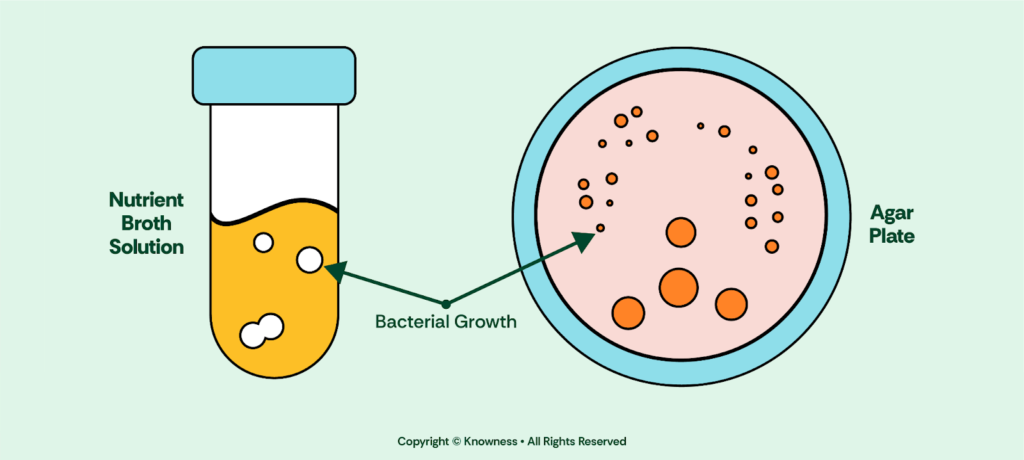
On the other hand, when grown on agar gel plates (a solid medium), the bacteria stay in one place. Agar is a jelly-like substance made from seaweed that contains nutrients needed for bacterial growth. When bacteria grow on agar, they form visible clusters called colonies. Each colonyA visible cluster of microorganisms growing on an agar plate, usually originating from one bacterium. usually develops from a single bacteriumA single-celled prokaryotic microorganism. that has multiplied many times.
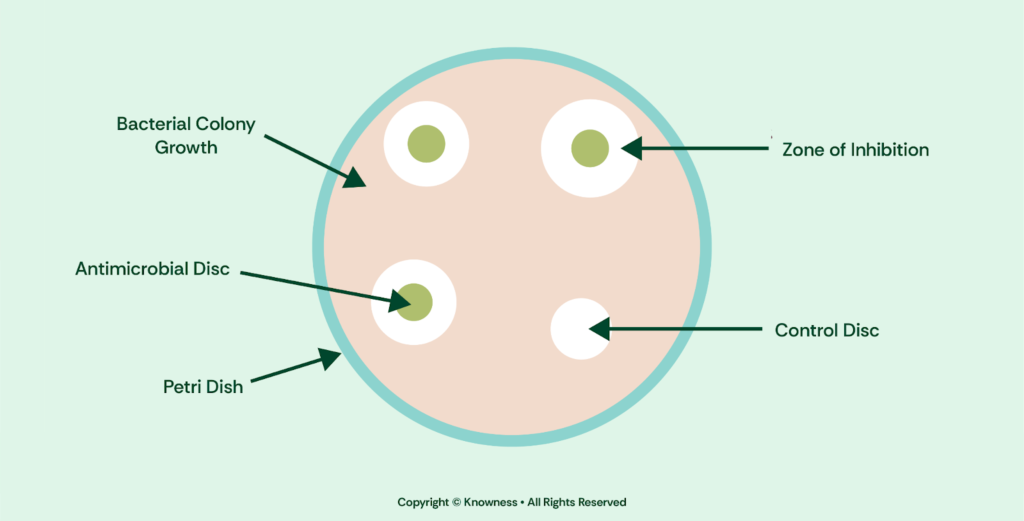
Agar plates can be used to test the effectiveness of antibiotics or disinfectants. Antibiotics are chemical substances that kill bacteria or prevent them from growing. Small discs soaked in these substances are placed on the agar surface, known as antimicrobial discs. If the substance prevents bacterial growth, a clear area called a zone of inhibitionA clear area around an antimicrobial disc on an agar plate where bacteria have not grown. forms around the disc. A control plateA Petri dish treated with sterile water instead of an antimicrobial substance for comparison in experiments., often treated with sterile water instead of an antimicrobial substance, is used for comparison to show how the bacteria grow when no antibiotic or disinfectant is present. The size of the zone of inhibition can then be measured to determine how effective the substance is, and we will cover this later in this lesson.
A solid medium is a nutrient material used to grow microorganisms that has been solidified, usually by adding agar. Unlike liquid media, which allow microorganisms to move freely, a solid medium keeps cells in one place so they grow into separate, visible colonies on the surface. Note
Aseptic Technique
When culturing microorganisms, it is important to prevent contamination. Contamination occurs when unwanted microorganisms enter the culture from the air, equipment, or the experimenter.
If contamination occurs, the results of the experiment may become unreliable, because other microorganisms may grow alongside the intended culture. Additionally, potentially harmful microorganisms could also spread. Therefore to ensure results are reliable and safe, aseptic techniques are used to prevent contamination. These techniques include:
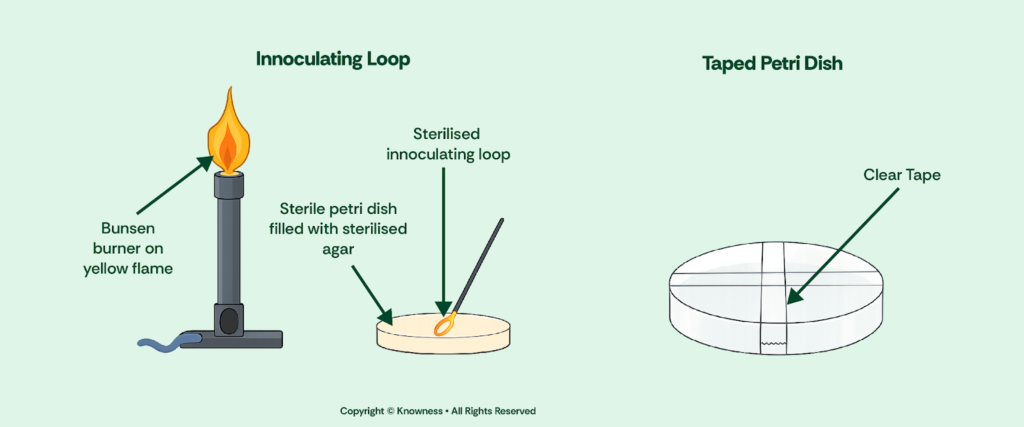
- Petri dishes and culture media are sterilised before use to destroy unwanted microorganisms. This means they are heated to kill any bacteria or fungi that could affect the results.
- Inoculating loops are passed through a flame (using a bunsen burner) until it is red-hot to kill any microbes present. Heating the loop destroys any bacteria on it, preventing unwanted microorganisms from being transferred to the culture.
- After bacteria are transferred, the lid of the Petri dish is secured with tape to reduce contamination while still allowing air in. Plates are incubated upside down to prevent condensation dripping onto the agar surface.
- In school laboratories, cultures are incubated at 25°C rather than 37°C as a safety precaution. This reduces the risk of growing harmful pathogens.
Measuring Colonies and Zones of Inhibition
The effectiveness of an antimicrobial substance can be assessed by measuring the diameter of the clear zone around a disc which indicates inhibition of microbial growth. To calculate the area of a circular zone, use the formula:
\(\text{Area} = \pi r^2\)
The area is usually expressed in mm² or cm². Always ensure units are consistent.Note
Estimating Bacterial Population Growth
Because bacteria divide by binary fission, populations double each generation. If the mean division time is known, the number of cells after a certain time can be estimated. The steps are as follows:
- First, make sure the total time and the mean division time are in the same units (for example, both in minutes).
- Next, divide the total time by the mean division time (\(\frac{\text{Total Time}}{\text{Mean Division Time}}\)). This tells you how many times the cells divide (the number of divisions).
- Each time cells divide, the population doubles. So instead of adding cells, you multiply the starting number by 2 for each division. This can be written as:
\(\text{Final Number of Cells} = \text{Starting Number} \times 2^n\)
This rapid doubling explains why bacterial infections can spread quickly and why controlling microbial growth is important in healthcare and public health.
Standard Form and Units HT
When dealing with very large or small measurements, it may be appropriate to express the calculated area in standard form. The units of area will depend on the unit used for the radius; typically mm² or cm². Ensure consistency in units throughout the calculation to maintain accuracy.