

GCSE
Biology
-
Introduction to GCSE Biology (AQA) Coming soon
-
1.1 Cell Structure
-
1.2 Cell Division Coming soon
-
1.3 Transport in Cells Coming soon
-
2.1 Principles of Organisation Coming soon
-
2.2 Animal Tissues, Organs and Organ Systems Coming soon
-
2.3 Plant Tissues, Organs and Systems Coming soon
-
3.1 Communicable Diseases Coming soon
-
3.2 Monoclonal Antibodies [HT] Coming soon
-
3.3 Plant Disease Coming soon
-
4.1 Photosynthesis Coming soon
-
4.2 Respiration Coming soon
-
5.1 Homeostasis Coming soon
-
5.2 The Human Nervous System Coming soon
-
5.3 Hormonal Coordination in Humans Coming soon
-
5.4 Plant Hormones Coming soon
-
6.1 Reproduction Coming soon
-
6.2 Variation and Evolution Coming soon
-
6.3 The Development of Understanding of Genetics and Evolution Coming soon
-
6.4 Classification of Living Organisms Coming soon
-
7.1 Adaptations, Interdependence and Competition Coming soon
-
7.2 Organisation of an Ecosystem Coming soon
-
7.3 Biodiversity and the Effect of Human Interaction on Ecosystems Coming soon
-
7.4 Trophic Levels in an Ecosystem Coming soon
-
7.5 Food Production Coming soon
1. Cell Biology
In this lesson, we will explore the process of cell differentiationThe process by which an unspecialised cell develops into a specialised cell with a specific function. and why it is essential in multicellular organisms. We will examine how unspecialised cells become specialised for particular functions, and compare differentiation in animals and plants, including the role of meristems in plant growth.
What is Cell Differentiation?
Cell differentiation is the process by which an unspecialised cell develops into a specialised cell with a particular structure and function. During the early stages of development, cells divide repeatedly. At first, these cells are unspecialised, but as development continues, some cells begin to change. They switch certain genes on and others off, allowing them to develop different structures suited to specific roles.
Cell differentiation is like students in school starting out the same but choosing different careers. Some become doctors (e.g., nerve cells for signalling), others become engineers (e.g., muscle cells for movement), each gaining unique skills and tools for their job.Analogy
Differentiation allows multicellular organisms to develop a wide variety of cell types. These specialised cells form tissues, tissues form organs, and organs work together in organA structure made of different tissues working together to perform a specific function. systems. Without differentiation, complex organisms could not function effectively.
Students sometimes forget that differentiated cells form tissues first, then organs, and finally systems. Avoid describing differentiation as directly creating organs without mentioning the steps of tissueA group of similar specialised cells working together to perform a function. and organ formation.Common Mistake
Cell Differentiation in Animals
In animals, most differentiation occurs at an early stage of development. Shortly after fertilisation, cells in the embryo begin to specialise into different types. As development continues, cells become increasingly specialised.
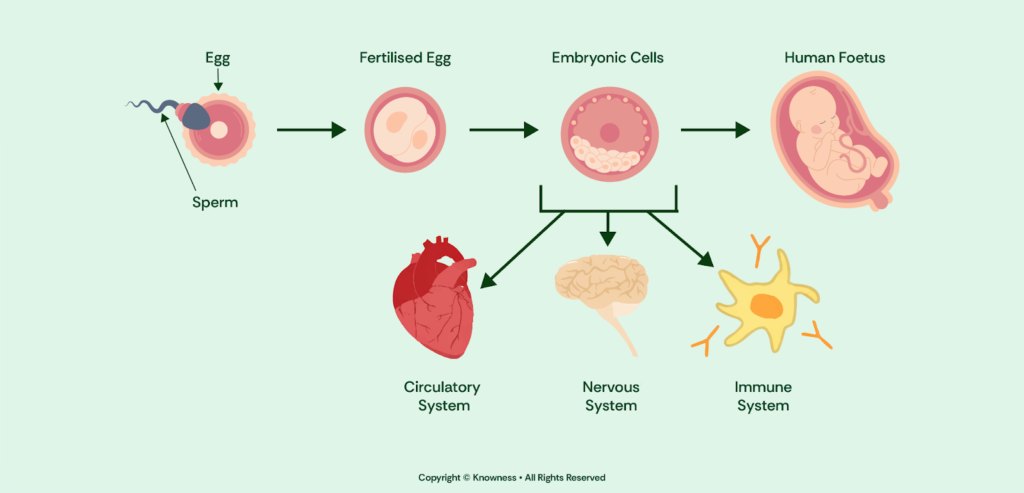
In mature animals, most cells have already differentiated and cannot change into other types. Cell division in adults mainly occurs for growth, repair and replacement of damaged or worn-out cells.
For example, in adults, skin cells and blood cells are constantly replaced, but nerve cells are rarely replaced.Example
Cell Differentiation in Plants
Unlike animals, many plant cells retain the ability to differentiate throughout their entire life. This allows plants to continue growing and producing new tissues even when they are mature.
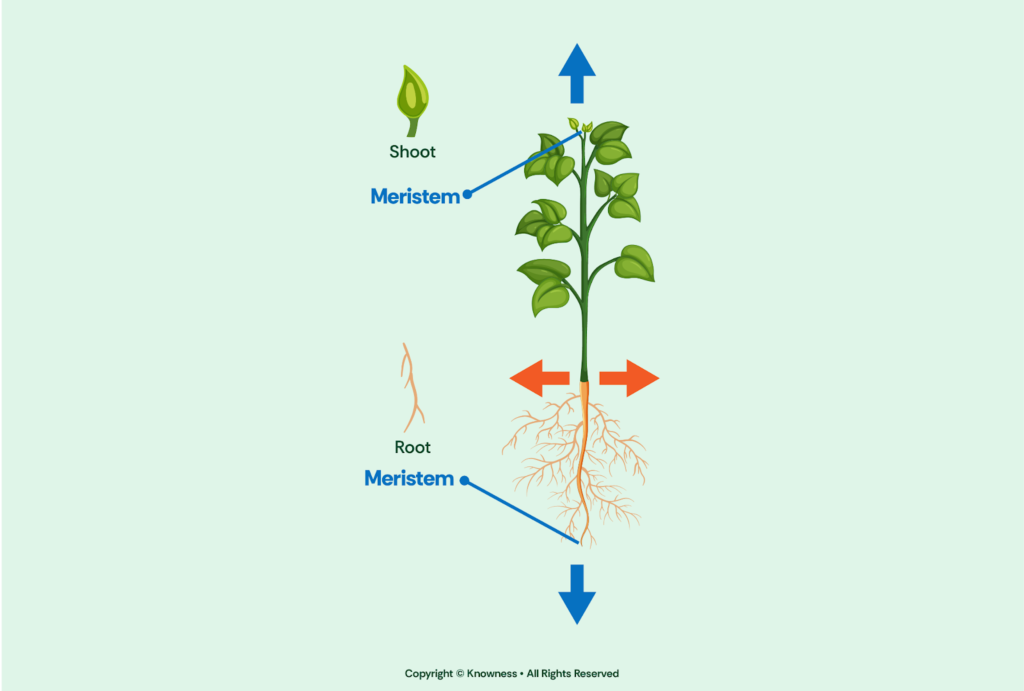
This ongoing differentiation occurs in regions called meristems. Meristems are areas of actively dividing, unspecialised cells found at the tips of roots and shoots. Cells in meristems can differentiate into various specialised plant cells, allowing the plant to grow taller, develop new leaves, and repair damage.
Think of plant meristems like a construction team that is always on standby. Whenever the plant needs to grow or repair itself, the team can produce new specialised workers (cells) to do the job.Analogy
Differentiation and Sub-Cellular Structures
During differentiation, cells develop specific sub-cellular structures that match their function. For example, a muscle cellA specialised animal cell adapted to contract and produce movement. develops many mitochondriaAn organelle where aerobic respiration occurs and energy is released. to provide energy for contraction, while a root hair cellA specialised plant cell adapted to absorb water and mineral ions from the soil. develops a long projection to increase surface area for absorption. A photosynthetic cell in a leaf develops chloroplasts to absorb light energy.
Differentiation does not mean that cells gain every possible structure. Instead, each specialised cell develops only the structures it needs to carry out its role effectively.
Do not assume all specialised cells contain the same organelles. For example, nerve cells do not contain chloroplasts, and root hair cells do not contain chloroplasts because they are underground.Common Mistake
What is Cell Differentiation?
- Cell differentiation is the process by which an unspecialised cell develops into a specialised cell with a particular structure and function.
- During early development, cells divide repeatedly and are initially unspecialised.
- As development continues, some cells switch certain genes on and others off, allowing them to develop structures suited to specific roles.
- Differentiation allows multicellular organisms to develop a wide variety of specialised cell types.
- Specialised cells form tissues, tissues form organs, and organs work together in organ systems.
- Without differentiation, complex organisms could not function effectively.
Cell Differentiation in Animals
- In animals, most differentiation occurs at an early stage of development.
- Shortly after fertilisation, embryonic cells begin to specialise into different types.
- As development continues, cells become increasingly specialised.
- In mature animals, most cells have already differentiated and cannot change into other types.
- In adults, cell division mainly occurs for growth, repair and replacement of damaged or worn-out cells.
Cell Differentiation in Plants
- Many plant cells retain the ability to differentiate throughout their entire life.
- This allows plants to continue growing and producing new tissues even when mature.
- Ongoing differentiation occurs in regions called meristems.
- Meristems are areas of actively dividing, unspecialised cells found at the tips of roots and shoots.
- Cells in meristems can differentiate into various specialised plant cells.
- This allows plants to grow taller, develop new leaves, and repair damage.
Differentiation and Sub-Cellular Structures
- During differentiation, cells develop specific sub-cellular structures that match their function.
- Specialised cells develop only the structures they need to carry out their role effectively.