

GCSE
Biology
-
Introduction to GCSE Biology (AQA) Coming soon
-
1.1 Cell Structure
-
1.2 Cell Division Coming soon
-
1.3 Transport in Cells Coming soon
-
2.1 Principles of Organisation Coming soon
-
2.2 Animal Tissues, Organs and Organ Systems Coming soon
-
2.3 Plant Tissues, Organs and Systems Coming soon
-
3.1 Communicable Diseases Coming soon
-
3.2 Monoclonal Antibodies [HT] Coming soon
-
3.3 Plant Disease Coming soon
-
4.1 Photosynthesis Coming soon
-
4.2 Respiration Coming soon
-
5.1 Homeostasis Coming soon
-
5.2 The Human Nervous System Coming soon
-
5.3 Hormonal Coordination in Humans Coming soon
-
5.4 Plant Hormones Coming soon
-
6.1 Reproduction Coming soon
-
6.2 Variation and Evolution Coming soon
-
6.3 The Development of Understanding of Genetics and Evolution Coming soon
-
6.4 Classification of Living Organisms Coming soon
-
7.1 Adaptations, Interdependence and Competition Coming soon
-
7.2 Organisation of an Ecosystem Coming soon
-
7.3 Biodiversity and the Effect of Human Interaction on Ecosystems Coming soon
-
7.4 Trophic Levels in an Ecosystem Coming soon
-
7.5 Food Production Coming soon
1. Cell Biology
1.1.1 Eukaryotes and Prokaryotes
In this lesson, we will compare eukaryotic and prokaryotic cells, exploring the structure of plant, animal, and bacterial cells, their differences in size, and how their genetic materialDNA that carries the instructions for cell structure and function. is organised. Additionally, we will develop an understanding of cell scale and perform order of magnitudeA comparison of size using powers of ten. calculations using standard formA way of writing very large or very small numbers as a number between 1 and 10 multiplied by a power of ten..
Eukaryotic Cells
Eukaryotic cells (plant and animal cells) make up the bodies of plants, animals, fungi and protists. They are generally larger and more complex than prokaryotic (bacterial) cells which we will explore later in this lesson. A key feature of eukaryotic cells is that their genetic material (DNA) is enclosed inside a nucleusA membrane-bound organelle in eukaryotic cells that contains DNA.. They also contain a cell membraneA thin, partially permeable barrier surrounding the cell that controls movement of substances in and out., cytoplasmA jelly-like substance in cells where most chemical reactions occur. and a range of specialised sub-cellular structures called organelles, each carrying out specific functions within the cell.
Students often assume that all cellular DNA is in the nucleus. Remember that mitochondriaAn organelle where aerobic respiration occurs and energy is released. (and chloroplasts in plants) also contain their own DNA. When asked where DNA is located, mention both nuclear and organelleA specialised structure within a cell that performs a particular function. DNA where relevant.Common Mistake
Animal Cells
Animal cells are eukaryotic cells that contain membrane-bound organelles. They have several key structures that allow them to carry out essential life processes.
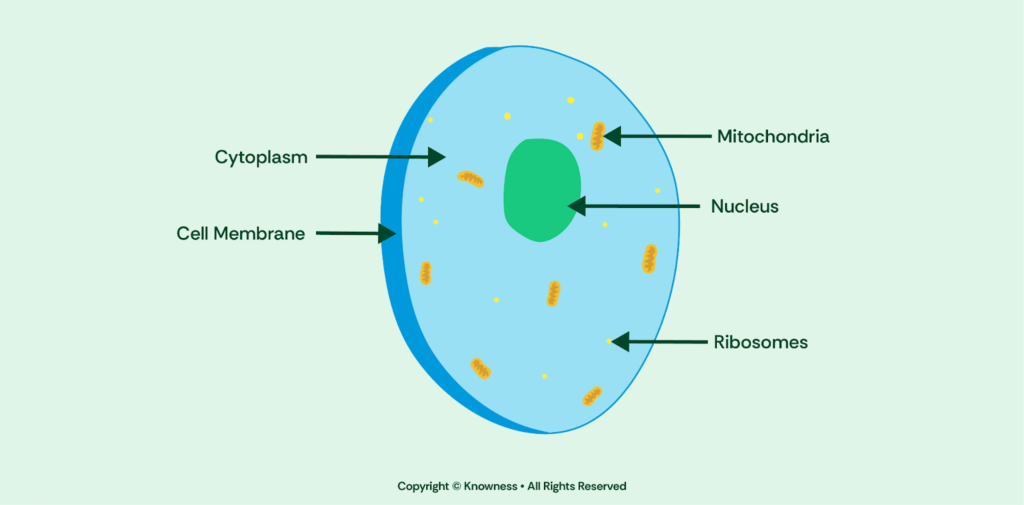
The nucleus contains chromosomes made of DNA and controls the activities of the cell. Mitochondria are the site of aerobic respirationA chemical process that releases energy from glucose using oxygen, occurring in mitochondria., where energy stored in glucose is released. Ribosomes are the site of protein synthesis. The cytoplasm is where most chemical reactions occur, controlled by enzymes. The cell membrane surrounds the cell and regulates the movement of substances in and out.
Plant Cells
Plant cells are also eukaryotic and contain the same basic structures as animal cells (nucleus, cytoplasm, cell membrane, mitochondria and ribosomes). However, they have additional structures that allow them to carry out photosynthesisThe process by which plants use light energy to produce glucose. and maintain structural support.
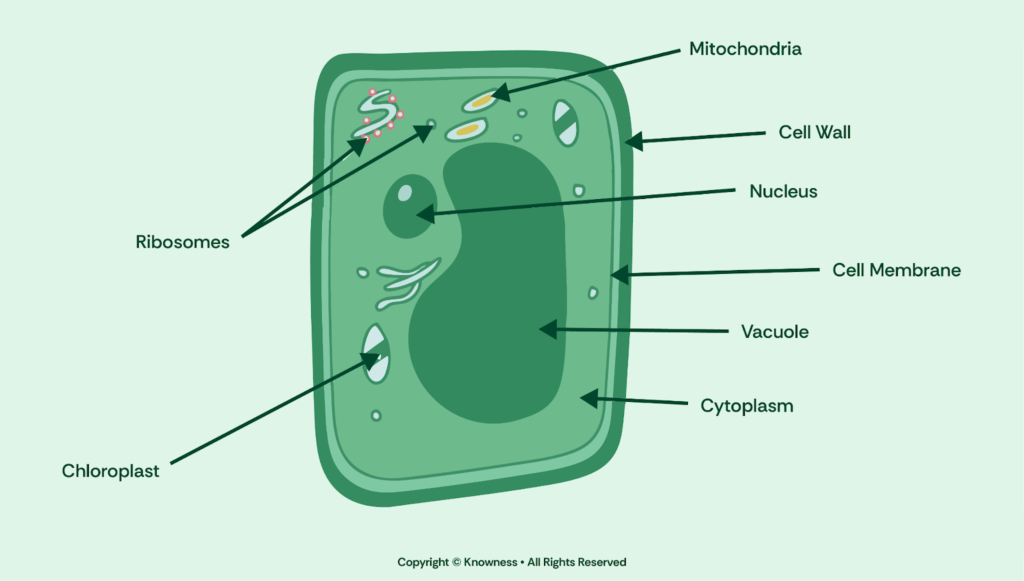
Plant cells have a cellulose cell wallA rigid outer layer that strengthens and supports the cell; made of cellulose in plants and peptidoglycan in bacteria. outside the cell membrane, which strengthens the cell. They often contain chloroplasts, which are the site of photosynthesis and contain chlorophyllA green pigment found in chloroplasts that absorbs light energy for photosynthesis. to absorb light. They also contain a large permanent vacuoleA fluid-filled space in plant cells that maintains internal pressure. filled with cell sapA weak solution of sugars and salts found in the vacuole of plant cells. (a solution of sugars and salts), which helps maintain internal pressure and keep the cell firm (turgid).
As we have now seen, the cell membrane, cytoplasm, nucleus, mitochondria, and ribosomes are features of both animal and plant cells. However, the cell wall, chloroplasts, and vacuole are features of plant cells only. This is detailed in Table 1 below.
| Feature | Explanation |
|---|---|
| Cell Membrane | A thin, flexible layer that surrounds the cell. It controls what substances enter and leave the cell. |
| Cytoplasm | A jelly-like substance where most chemical reactions happen. It contains enzymes that control these reactions and ribosomes for making proteins. |
| Nucleus | Contains the cell’s genetic material (DNA) arranged in chromosomes. It controls the activities of the cell, including growth and protein production. |
| Mitochondria | The site of aerobic respiration where energy is released. They release energy from glucose, which the cell uses for activities such as growth and repair. |
| Ribosomes | Tiny structures where proteins are made. Proteins are needed for growth, repair, and carrying out chemical reactions. |
| Cell Wall (Plant Cells Only) | A rigid outer layer made of cellulose. It strengthens the cell, supports its shape, and prevents it from bursting. |
| Chloroplasts (Plant Cells Only) | The site of photosynthesis. They contain chlorophyll, which absorbs light energy to make glucose. |
| Vacuole (Plant Cells Only) | A large space filled with cell sap (a weak solution of sugars and salts). It helps keep the cell firm by maintaining internal pressure. |
This compartmentalisation in eukaryotic cells allows different processes to occur efficiently at the same time, which is important for complex and multicellular organisms.
Think of a eukaryotic cell like a factory building: the nucleus is the office with blueprints (DNA), mitochondria are the power generators, and ribosomes are the assembly lines that build products (proteins).Analogy
Prokaryotic Cells
Prokaryotic cells are bacterial cells. They are much smaller than eukaryotic cells and are always single-celled organisms. Unlike eukaryotic cells, prokaryotes do not have a nucleus and do not have membrane-bound organelles. Their genetic material is not enclosed within a nuclear membrane. Instead, the chromosomal DNA forms a single circular loop that lies free in the cytoplasm. Many bacteriaA single-celled prokaryotic microorganism. also contain plasmids which are small, circular DNAA single loop of DNA found free in the cytoplasm of prokaryotic cells. molecules separate from the main chromosomeA structure made of DNA that carries genetic information..
Many students assume “no nucleus” means no DNA. Prokaryotes still have DNA but it is just not enclosed by a nuclear membrane. When asked to compare cells, don’t say that prokaryotes “have no genetic material.”Common Mistake
Plasmids often carry genes for antibiotic resistance or other useful traits and can sometimes be transferred between bacteria.Footnote
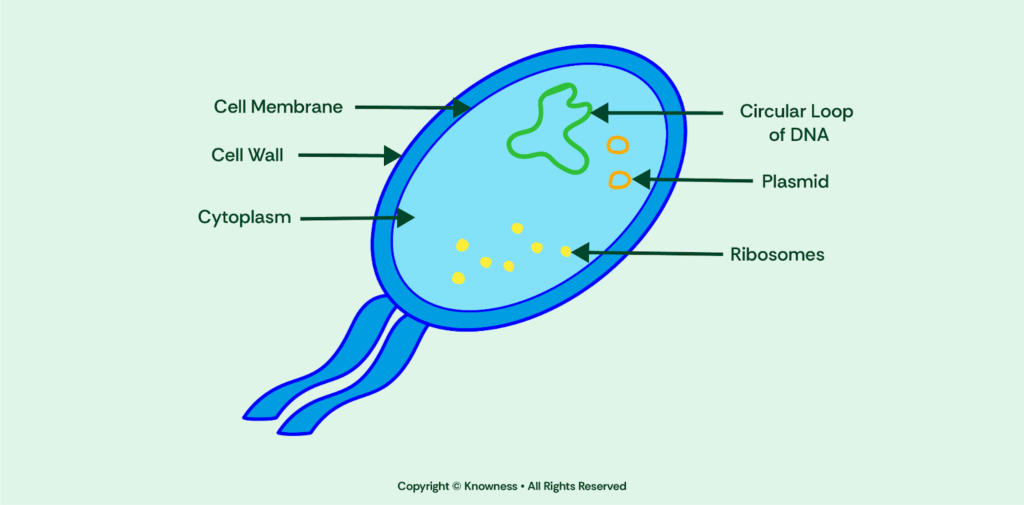
Ribosomes are present in prokaryotic cells and are the site of protein synthesis, but they are smaller than those found in eukaryotic cells. Important processes such as respiration occur in the cytoplasm and at the cell membrane rather than inside mitochondria.
Think of a prokaryotic cell like an open-plan workshop where tools and workers share the same floor space; tasks happen quickly without moving items between rooms.Analogy
| Feature | Explanation |
|---|---|
| Cell Membrane | A thin layer that surrounds the cell. It controls the movement of substances into and out of the cell. |
| Cytoplasm | A jelly-like substance where chemical reactions take place. It contains enzymes and small ribosomes for making proteins. |
| Cell Wall | A strong outer layer that supports and protects the cell. In bacteria, it is made of a substance called peptidoglycanA substance forming the cell wall of bacterial cells., not cellulose. |
| Circular DNA | A single loop of chromosomal DNA found free in the cytoplasm. It controls the cell’s activities but is not enclosed in a nucleus. |
| Plasmids | Small circular rings of extra DNA found in the cytoplasm. They often contain genes that may give advantages, such as antibiotic resistance. |
| Ribosomes | Small structures where proteins are made. Prokaryotic ribosomes are smaller than those in eukaryotic cells. |
Although prokaryotes are structurally simpler, they are highly successful organisms that reproduce rapidly and can survive in a wide range of environments.
Scale and Size of Cells
Bacterial cells are significantly smaller than eukaryotic cells. Eukaryotic cells typically range from 10 to 100 micrometres (μm) in diameter. Prokaryotic cells, such as bacteria, usually range from 1 to 5 micrometres (μm).
Because cells are so small, we use metric units with prefixes:
- A centimetre (cm) is equal to one hundredth of a metre (\(1 \times 10^{-2} \text{m}\)).
- A millimetre (mm) is equal to one thousandth of a metre (\(1 \times 10^{-3} \text{m}\)).
- A micrometre (μm) is equal to one millionth of a metre (\(1 \times 10^{-6} \text{m}\)).
- A nanometer (nm) is equal to one billionth of a metre (\(1 \times 10^{-9} \text{m}\)).
- A picometer (pm) is equal to one trillionth of a metre (\(1 \times 10^{-12} \text{m}\)).
Orders of magnitude describe differences in size using powers of 10. Moving up one order of magnitude means multiplying by 10. Moving down one order of magnitude means dividing by 10. Eukaryotic cells are approximately 10 times larger than prokaryotic cells, which means approximately one order of magnitude.
Standard form is a way to write very large or very small numbers in the form: \(a \times 10^b\), where \(a\) is a number between 1 and 10, and \(b\) is the power of 10.
Suppose we want to compare the size of a eukaryotic cell (20 μm) and a bacterial cell (2 μm). We can round them to the nearest power of 10: 20 μm ≈ 101 μm and 2 μm ≈ 100 μm. The difference in order of magnitude is 1, indicating that eukaryotic cells are approximately 10 times larger than bacterial cells.Example
The symbol ≈ means ‘is approximately equal to’.Note
Eukaryotic Cells
- Eukaryotic cells make up plants, animals, fungi and protists and are larger and more complex than prokaryotic cells.
- Their genetic material (DNA) is enclosed inside a nucleus.
- They contain a cell membrane, cytoplasm and membrane-bound organelles with specific functions.
- In animal cells, the nucleus contains chromosomes made of DNA and controls cell activities.
- Mitochondria are the site of aerobic respiration where energy is released from glucose.
- Ribosomes are the site of protein synthesis.
- The cytoplasm is where most chemical reactions occur and contains enzymes.
- The cell membrane regulates movement of substances into and out of the cell.
- Plant cells contain the same basic structures as animal cells.
- Plant cells have a cellulose cell wall that strengthens and supports the cell.
- Plant cells contain chloroplasts, the site of photosynthesis, which contain chlorophyll to absorb light.
- Plant cells have a large permanent vacuole filled with cell sap that maintains internal pressure and keeps the cell turgid.
- Compartmentalisation allows different processes to occur efficiently at the same time.
Prokaryotic Cells
- Prokaryotic cells are bacterial cells and are always single-celled organisms.
- They are much smaller than eukaryotic cells.
- They do not have a nucleus and do not have membrane-bound organelles.
- Their genetic material forms a single circular loop of DNA free in the cytoplasm.
- Many bacteria contain plasmids, which are small circular rings of extra DNA.
- Ribosomes are present and are the site of protein synthesis, but are smaller than in eukaryotes.
- Respiration occurs in the cytoplasm and at the cell membrane rather than in mitochondria.
- The cell wall is made of peptidoglycan, not cellulose.
- Despite being structurally simpler, prokaryotes reproduce rapidly and survive in a wide range of environments.
Scale and Size of Cells
- Eukaryotic cells typically range from 10–100 μm in diameter.
- Prokaryotic cells usually range from 1–5 μm.
- A centimetre (cm) is \(1 \times 10^{-2} \text{m}\) metres.
- A millimetre (mm) is \(1 \times 10^{-3} \text{m}\) metres.
- A micrometre (μm) is \(1 \times 10^{-6} \text{m}\) metres.
- A nanometre (nm) is \(1 \times 10^{-9} \text{m}\) metres.
- A picometre (pm) is \(1 \times 10^{-12} \text{m}\) metres.
- An order of magnitude is a difference of a factor of 10.
- Moving up one order of magnitude means multiplying by 10.
- Moving down one order of magnitude means dividing by 10.
- Standard form writes numbers as a number between 1 and 10 multiplied by a power of 10.
- Eukaryotic cells are approximately one order of magnitude (10 times) larger than prokaryotic cells.