

3.1 Institutions of the United Kingdom
The UK uses a system based on the political thinker Montesquieu’s notion of splitting governmentThe public authority that provides services, collects taxes, sets laws and regulations, and helps manage the economy. power into three parts. These are the legislative, which makes laws; the executive, which puts laws into action; and the judiciary, which interprets laws and checks that they are followed correctly. Montesquieu believed this division was important to stop any one person or group from having too much power.
Parliament
Parliament is the legislative branch of the UK government, responsible for making, amending, and repealing laws. It consists of two houses (or chambers): the House of Commons and the House of Lords.
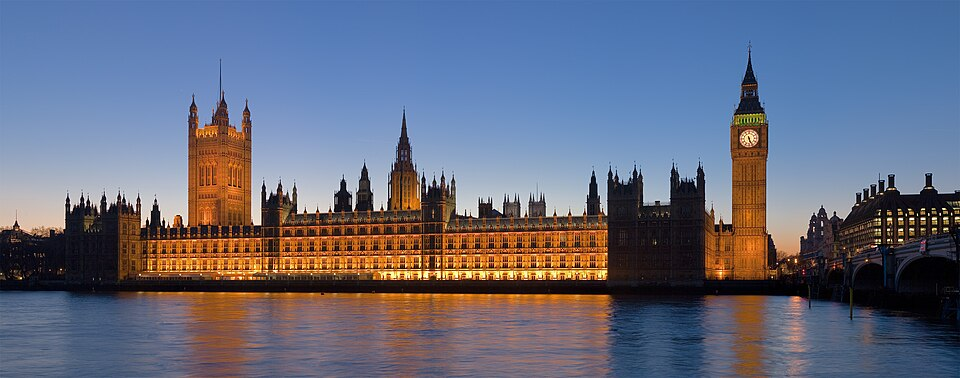
The House of Commons
The members of the House of Commons are elected representatives. Members of Parliament (MPs) are voted for by the public in elections in order to speak and act on behalf of the people in their local areas, called constituencies. It is the responsibility of MPs to raise concerns, voice opinions, and work on behalf of their communities in Parliament. They discuss important national issues, suggest changes to laws, and make decisions that affect the entire country while keeping the needs of their local areas in mind. MPs play an essential role in connecting the government with the people they represent.
The functions of the House of Commons are as follows:
- The House of Commons is the main place where UK laws are created and decided. Members of Parliament (MPs) suggest new laws, discuss them, and vote to decide if they should be approved.
- The Commons also checks what the government is doing to make sure it is acting properly and making good decisions. MPs hold discussions, called debates, to talk about government actions and ask important questions. There are also special groups, called select committees, that look closely at specific government plans or policies. These committees gather information and check that everything is being done fairly and correctly.
House of Lords
The House of Lords, on the other hand, is an unelected chamber. The House of Lords is a part of the UK Parliament, and its members come from different groups. It includes life peers, who are chosen because of their knowledge, skills, or contributions to society. These members are appointed for their lifetime and do not pass their titles to their children. It also includes bishops from the Church of England, who contribute a religious perspectiveA writer’s viewpoint or stance. to discussions. Finally, there are some hereditary peers, who have inherited their position through family ties. However, the number of hereditary peers allowed in the House of Lords is limited to a small group.
The role of the House of Lords is as follows:
- Although it is not an elected chamber, the House of Lords acts as a revising chamber, looking in detail at and suggesting amendments to legislation proposed by the House of Commons. The Lords can delay legislation but cannot say no to it indefinitely, as the Parliament Acts of 1911 and 1949 limit its power.
- The House of Lords plays an important role in checking and improving laws made by the House of Commons. Its members use their experience and expertise to review and suggest changes to laws, ensuring they are well thought-out and work in the best interest of the country. This diverse mix of members helps the House of Lords bring many different viewpoints to the UK’s law-making process.
In the UK, Parliament, which is formed by the Commons and Lords, is the most powerful part of the government when it comes to creating and changing laws. Parliament can make new laws or get rid of old ones, and no other group or body can overrule its decisions.Note