

2.2 How Laws are Formed and the Different Types of Law
Making laws is a detailed process with several steps, starting from the idea for a law to it being applied and followed. Usually, making laws is the job of the governmentThe public authority that provides services, collects taxes, sets laws and regulations, and helps manage the economy. (in the contextA discrete unit of archaeological evidence, such as a layer of soil, a structure, or a feature, that can be recorded and interpreted. of the UK, it would be the UK government). However, other groups, like international organisations or local community groups, can also help shape laws.
Legislative Process
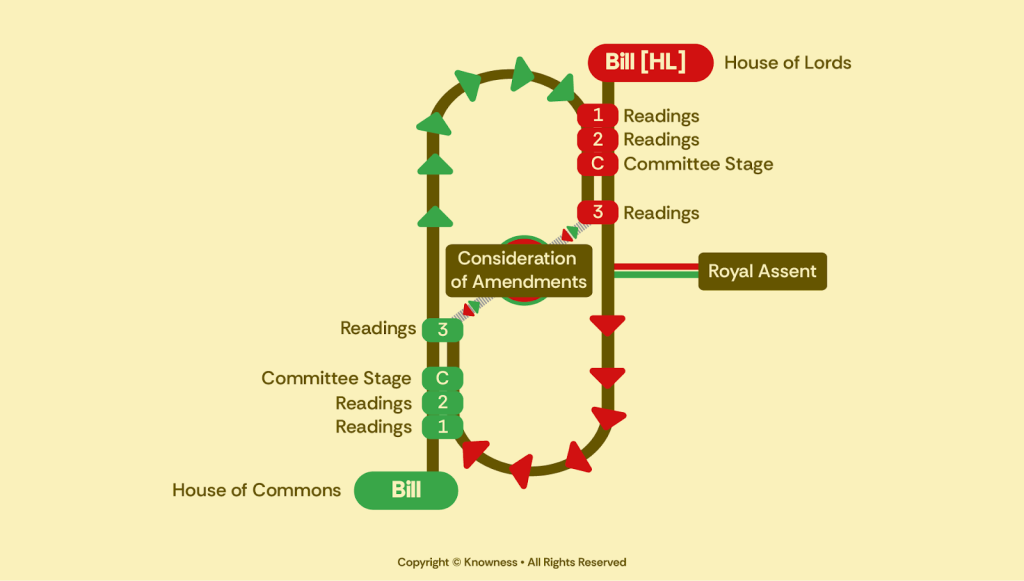
In democratic countries like the UK, laws go through a long process to make sure they’re fair and useful. It all starts with an idea, this could come from a Member of Parliament (MP), the Prime Minister, or even a group who think a law needs to be made or changed. This idea is called a bill.
Once a bill is introduced, MPs discuss it in several readings, debating whether it’s a good idea and whether it is missing or includes anything that needs to be reviewed. After that, it’s sent to committees, where legal experts take a closer look, suggest changes, and refine it to make sure it’s practical. If needed, another reading stage is arranged so that any amendments are added to improve the bill before it’s voted on.
If most MPs agree on the bill, it moves forward. The final step is approval from the monarch (the King or Queen) or another leader, like a president in some countries. Once they say yes, the bill officially becomes law, meaning everyone must follow it.
Some laws are decided through referendums, where ordinary people vote directly on big issues. This makes the lawmaking process more democratic, because citizens get a say in important decisions, not just politicians. A famous and recent example of a referendum is Brexit, where the people of the UK voted on whether or not the UK would leave the European Union (EU). 52% of people voted to leave the EU and the UK then started the process as it had gained popular approval.