4.2 The Insane Lifecycle
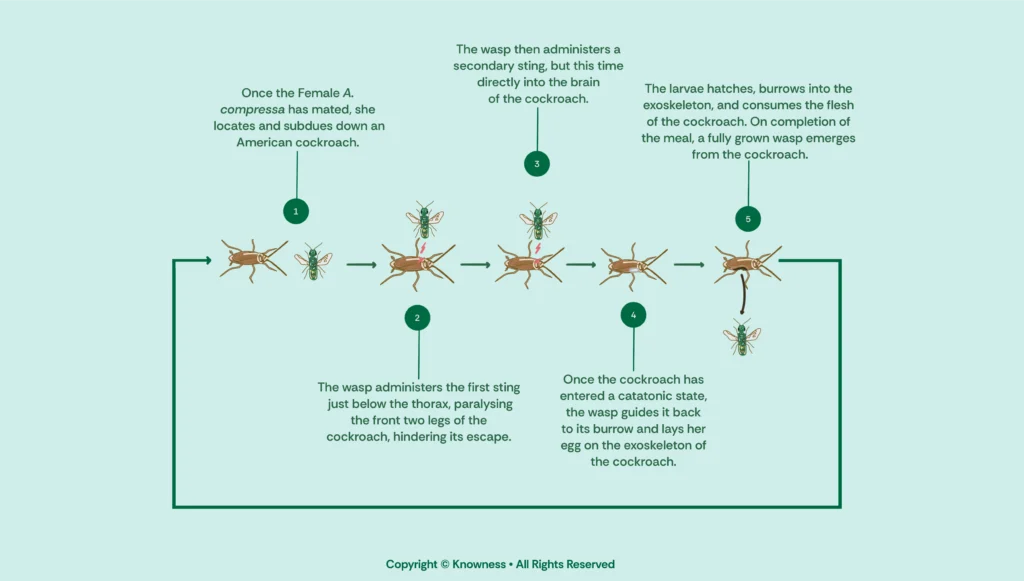
This life cycle is initiated once a female wasp has mated and is ready to lay her fertilised eggs. In order for her eggs to survive they need a nutrient source.
The female goes on the hunt for a suitable host for her larva; the American cockroach. Once she locates her target and locks on, she starts her mission with a precision unlike any other.
Her first move is to wrestle the cockroach into an exposed position, preferably on its back so she can place the first sting just below the thorax and just above the front two legs. Wrestling with a cockroach almost twice your size is no easy feat. Once she has managed to secure this first sting, it results in the muscle paralysis of the front pair of legs of the cockroach, rendering her victim immobile. Now the cockroach cannot escape.
Now that the cockroach is not so strugglesome, she can administer her second, and most important sting. With this sting she has to be incredibly precise as this dose of venom is going directly into the brain of the cockroach, specifically the subesophageal ganglion; if she administers too high of a dose, she will end up killing the cockroach meaning her eggs will not have a fresh supply of nutrients to hatch into. If she delivers too low a quantity of venom, eventually the dose administered to paralyse the legs of the cockroach will wear off, allowing the cockroach to regain control of its legs and escape the wasp. This may also encourage the wasp to administer more stings to the brain, increasing the likelihood of fatality in the cockroach.
Upon a successful administration of the second sting into the mind of the cockroach, the wasp then rests and rejuvenates after beating the cockroach. Some wasps may snip off one of the cockroaches antennae with its mandibles to drink some mouthfuls of cockroach hemolymph, refuelling for the remainder of the mission. The purposeThe reason for writing (to inform, persuade, describe, etc.). of this secondary sting is to place the cockroach into a catatonic state, rendering the cockroach completely devoid of its own autonomy. The chance of the cockroach escaping the clutches of the Jewelled wasp on its own volition now are extremely minimal.
You may think the most challenging part of the task this wasp has is over; she has the cockroach at her mercy. She’s won. However, this is only half of the story. She now has to guide this immobilised cockroach back to her burrow where she can lay her eggs. This means dragging a cockroach which is twice her weight twice her size all the way back to her lair, whilst defending her catch from other predators who may view her cockroach and even her as a scrumptious complimentary meal. The wasp is in a very vulnerable stage at this part of the cycle, as the majority of her attention is getting this immobile insect back to her burrow, hence she is not focused on defending herself from attacks.
Once she successfully manages to guide the cockroach back to her burrow, she sets to work immediately. She lays a single egg on the exoskeleton of the cockroach and begins sealing the only entry and exit to the burrow with sediment.
The larva hatches and begins to burrow through the exoskeleton and begins to feast on the fresh meat its mother has provided. Here is where it gets incredibly interesting again; The larva intentionally avoids consuming the brain, heart and other internal organs of the cockroach first, instead choosing to devour the more fatty tissueA group of similar specialised cells working together to perform a function. stores the cockroach possesses. The reason for this being, if the wasp larva was to consume or damage any of the internal organs first, it is quite likely that the cockroach would succumb to this internal damage, causing its flesh to start rotting. Hence, to keep the cockroach fresh for as long as possible, the larva knows to consume the internal organs in its final stages as a larva. Remember, this is all occurring whilst the cockroach is alive. It may be paralysed and in a catatonic ‘zombie’ like state but It’s still conscious, and feels every bite the wasp larva takes from its flesh.
Once the larva is ready in its cycle to transition to a fully grown wasp, a process which takes approximately 4 - 5 days, the larva begins to synthesise its cocoon around the cockroach. The larva then consumes the internal organs of the cockroach, killing it. Eventually a fully formed emerald coloured jewelled cockroach wasp emerges from the empty husk of an exoskeleton of a cockroach, bursting from its cocoon. The life cycle begins again, unless you’re a male cockroach wasp.