3: Microbiology
In this module, we’ll explore Mycobacterium tuberculosis, the Gram-positive bacteriumA single-celled prokaryotic microorganism. behind tuberculosis, which infects 25% of the global population in its latent form. With 1.5 million deaths annually, it primarily targets the lungs through aerosol transmission.
You’ll gain insight into how this pathogen survives within immune cells and the challenges posed by multidrug-resistant strains, highlighting why it remains one of the most formidable threats in global health.
Let’s dive into how TB causes disease and impacts human health, whilst also exploring its more virulent forms due to antibiotic resistance.
Process of Infection
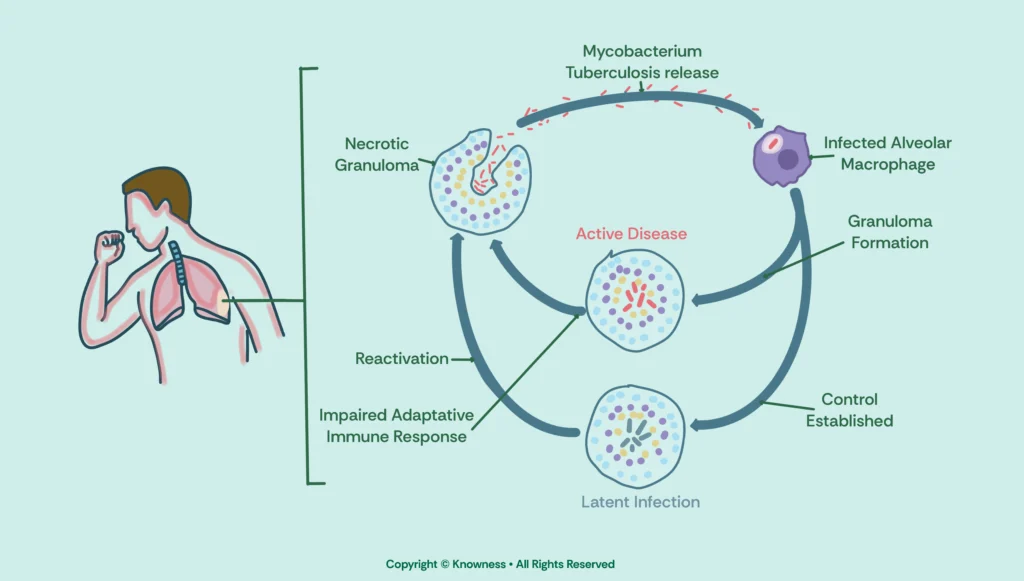
The bacteriaA single-celled prokaryotic microorganism. colonises the niche host environment within the lungs, picking alveolar lining as a suitable location. It is here where the bacterium is engulfed by alveolar macrophages and here is where the Mycobacterium tuberculosis activates its superpower, as the infection process has two routes:
- Active Tuberculosis: This pathogen is able to survive within a leukocyte (white blood cells) by hindering phagosome maturation. It is able to do this by preventing phagosomes and lysosomes from fusing. If these two vesicles are not able to form their complex, they fail to degrade the Mycobacterium tuberculosis bacterial cells via digestive enzymes they had originally contained. Hence, when the bacteria emerge from lysed phagocytes, they begin to multiply rapidly. Many leukocytes are sent to conduct damage control, but if it is not enough, then an active form of tuberculosis will persist.
- Latent Tuberculosis: If the containment is successful via the intense immune response, a granuloma will form; a granuloma is a structured collection of immune cells, primarily macrophages, that forms in the lungs (or other tissues) as the body’s immune response to the infection. When Mycobacterium tuberculosis invades, the immune system attempts to contain the bacteria by surrounding it with leukocytes, creating a granuloma to isolate and prevent its spread. Inside the granuloma, macrophages engulf the bacteria, but Mycobacterium tuberculosis bacteria have evolved mechanisms to survive inside these cells. The granuloma often becomes a chronic, dynamic environmentA business environment that is constantly changing and requires businesses to adapt. where the bacteria can persist in their latent form or slow-growing state, shielded from the immune system and from antibiotics, especially in drug-resistant cases. Over time, if the granuloma breaks down, the bacteria can be released and become active, leading to further tissueA group of similar specialised cells working together to perform a function. damage and transmission.
Thus, in Mycobacterium tuberculosis, granulomas not only reflect the body's attempt to control the infection but also highlight the challenges of treating the disease due to the bacteria’s ability to survive in such protected environments.