2.3 The Ingenuity of CRISPR-Cas9
When CRISPR Cas9 was initially discovered, geneticists all around the world were overcome with great shock and awe. This was due to the revolution which was about to overtake the world of genetic engineering. That being said, this new discovery and its ability to contribute to novel genetic technologies did come with its fair share of concerns.
What is CRISPR-Cas9?
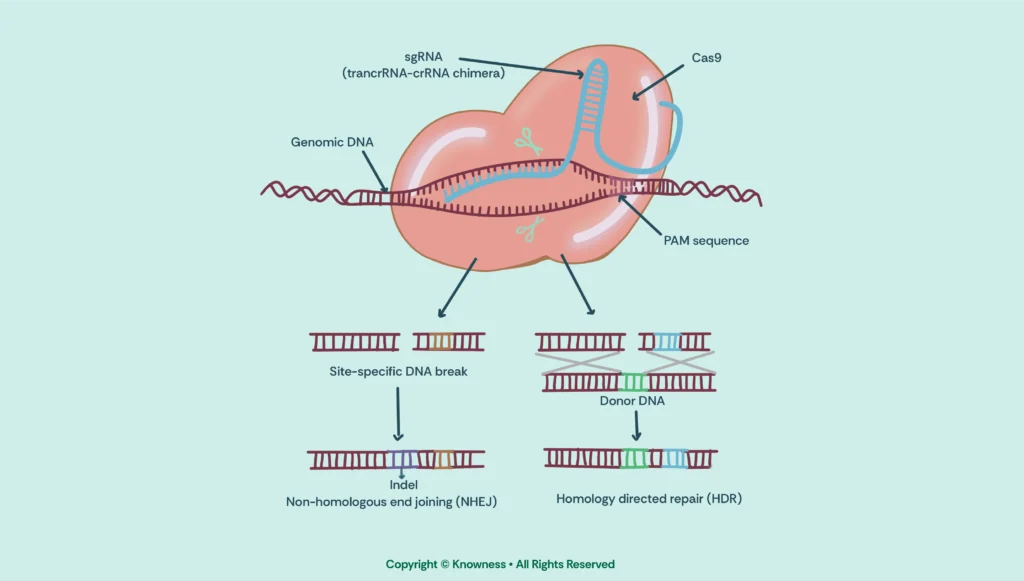
CRISPR-Cas9 (Clustered Regularly Interspaced Short Palindromic Repeats and CRISPR-associated protein 9) is a tool that allows scientists to edit genes by making precise changes in the DNA sequence. It acts like molecular "scissors," cutting the DNA at a specific location, and then allowing new genetic materialDNA that carries the instructions for cell structure and function. to be inserted or a mutation to be repaired.
CRISPR refers to the repeated sequences of DNA found in bacterial genomes, which act as a kind of "genetic memory" of viruses that have attacked the bacteriumA single-celled prokaryotic microorganism.. Cas9 is a protein (nuclease) associated with the CRISPR system that cuts DNA at a specific site, guided by a piece of RNA.
What is CRISPR-Cas originally used for in bacteriaA single-celled prokaryotic microorganism.?
CRISPR-Cas9 is a significant part of the immune system of bacteria. It allows bacteria to "remember" (a form of adaptive immunity if you will) and defend themselves against viral invaders (bacteriophages). Here’s how it works in bacteria:
The CRISPR Immune Mechanism
- Phase 1 - Viral Invasion: When a virus attacks a bacterium, it injects its DNA into the bacterial cell.
- Phase 2 - Adaptation: If the bacterium survives, it stores a small piece of the virus’s DNA within its own genome at the CRISPR loci. This viral DNA fragment (called a spacer) is stored between the CRISPR repeat sequences.
- Phase 3 - Immunity/Interference: When the same virus tries to attack again, the bacterium transcribes the stored viral DNA into a piece of RNA (called crRNA). This crRNA pairs with a helper RNA (called tracrRNA) to form a complex with the Cas9 protein. The crRNA guides Cas9 to the viral DNA, where Cas9 cuts and destroys the invading DNA, preventing infection. This immune system gives bacteria a type of adaptive immunity, allowing them to target and neutralise invaders based on their genetic history.
The Two Pioneering Women
The CRISPR-Cas9 system, discovered by Jennifer Doudna and Emmanuelle Charpentier, revolutionised gene editing by simplifying a bacterial immune mechanism.

Charpentier's work on Streptococcus pyogenes revealed tracrRNA, a crucial element that helps guide the Cas9 protein to cut specific DNA sequences. Doudna, a biochemist, collaborated with Charpentier to streamlineRepresented by a line in mechanical sketches/drawings, the fluid velocity is constant along this. this system into a two-component model—crRNA (guide RNA) and Cas9—demonstrating that it could be programmed to target any DNA sequence.
Their groundbreaking 2012 paper laid the foundation for modern genome editing, and in 2020, they became the first women to jointly win the Nobel Prize in Chemistry.
CRISPR-Cas9 Applications in the Modern Era
The discovery of CRISPR-Cas9 has revolutionised the field of genetics, offering the ability to precisely edit genes for a wide range of applications:
- Medicine: CRISPR-Cas9 has immense potential in treating genetic disorders by repairing or replacing faulty genes. For instance, it has been used to edit genes responsible for blood disorders like sickle cell disease and beta-thalassemia by correcting mutations in blood stem cells. In cystic fibrosis, CRISPR is being explored to repair the defective CFTR gene. Additionally, CRISPR is being used in cancer treatment by engineering immune cells (T cells) to better recognise and destroy cancer cells, with clinical trials underway. There is also promise in using CRISPR to fight viral infections, such as HIV, and possibly targeting the SARS-CoV-2 virus in COVID-19 treatment.
- Agriculture: CRISPR is transforming agriculture by creating crops that are more resistant to diseases, pests, and harsh environmental conditions like drought. Scientists are editing genes to enhance growth, resistance, and nutritional content in plants such as disease-resistant wheat and drought-resistant tomatoes and rice. In livestock, CRISPR has been used to engineer disease-resistant pigs and cattle, improve meat quality, and create animals that grow faster or produce more offspring, contributing to more sustainable and efficient farming practices.
- Genetic Research: In research, CRISPR has revolutionised the creation of genetically modified organisms, particularly model organisms like mice, to study human diseases and gene functions. Scientists can now quickly generate models with specific mutations to explore disease mechanisms and test new treatments. CRISPR also enables functional genomics, allowing researchers to knock out specific genes to uncover their roles in cell biology, development, and disease, aiding in the discovery of new drug targets for future therapies.