4.2 Open Channel Flow and Manning’s Equation
Open channel flow is influenced by factors like channel geometry, slope, and roughness. Understanding open channel flow is crucial for the design of effective drainage systems, flood control measures, and irrigation systems. This lesson will provide the foundation needed for analysing and designing water flow systems in Civil Engineering.
Manning’s Equation
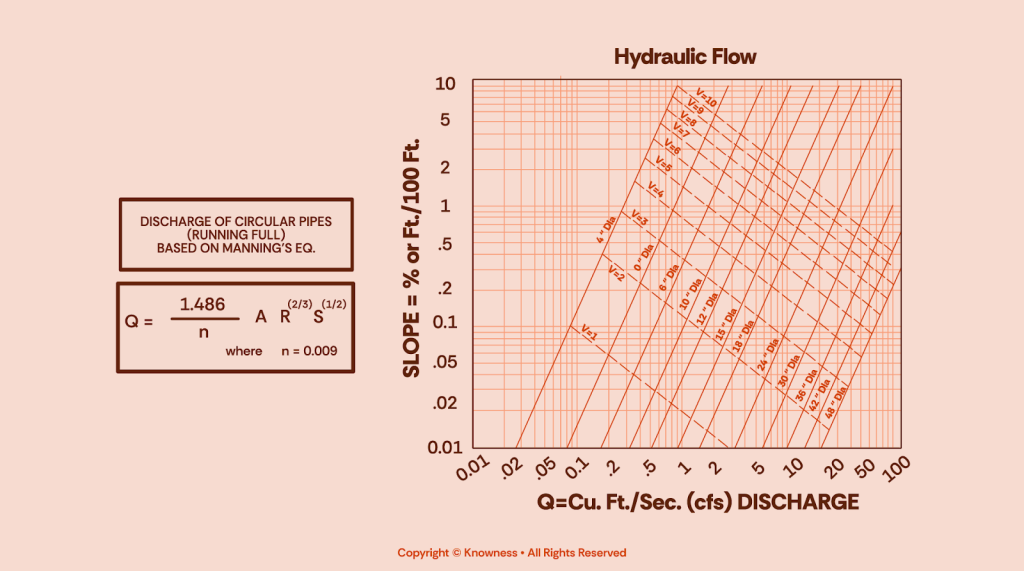
For water flowing in open channels, Manning’s equation is used to estimate velocity:
\(v =\frac{1}{n}R^{\frac{2}{3}}S^{\frac{1}{2}}\)
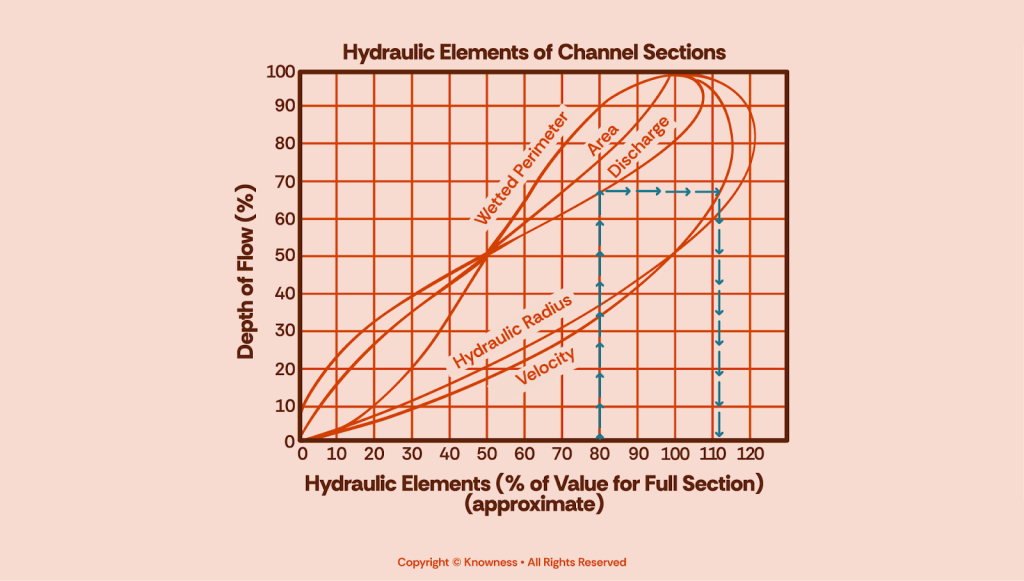
The hydraulic radius, \(R\), is the flow cross sectional area divided by the wetted perimeter or the length of the cross section which is in contact with the flowing water. For circular pipes running full, this can be taken as the diameter divided by 4. The hydraulic gradient or slope, \(S\), is effectively the downward slope of the pipe in metres, m.
Manning’s Roughness Coefficient, \(n\), is an empirical coefficient used to allow for the frictional losses caused by the internal roughness of the pipe. It is derived from experiments and testing in which a range of values have been established.
The formula is an approximation of the Colebrook-White Equation and hence flow conditions must lie within the following range in order to maintain the accuracy of the Manning formula:
- The relative roughness (\(\frac{R}{k}\)) is between 7 and 130.
- The flow should be fully turbulent, ie\(\frac{v_k}{v} > 807\).
These parameters and the derivation from the Colebrook-White Equation are advanced and will not be covered in this course. For all examples, you can assume that these conditions are met, or the appropriate Manning’s coefficient will be given.