

General
Physics
Particle Physics
Particle physics is the study of the fundamental particles that make up the universe and the forces that govern their behavior. It is based on the principles of quantum mechanicsThe theory used to describe the behaviour of very small particles (atomic and subatomic level). Unlike classical physics which is deterministic, quantum mechanics is a probabilistic theory. and special relativity, and it seeks to understand the nature of matter and the fundamental interactions between particles.
There are several theories that seek to describe the fundamental particles and forces of nature, including the standard model of particle physics.
The standard model is a theoretical framework that helps us understand the fundamental building blocks of our universe and the forces that govern their behavior. It describes the behavior of particles at the atomic and subatomic scale and it is based on the principles of quantum mechanics and special relativity.
The standard model consists of three fundamental forces: the strong nuclear force, the weak nuclear force, and the electromagnetic force.
- The strong nuclear force is responsible for binding protons and neutrons together in the nucleusA membrane-bound organelle in eukaryotic cells that contains DNA. of an atom.
- The weak nuclear force is responsible for certain types of radioactive decay.
- The electromagnetic force is responsible for the interaction of charged particles, such as electrons and protons, and it is responsible for phenomena such as electricity and magnetism.
The standard model also includes a number of fundamental particles, including quarks and leptons and Bosons:
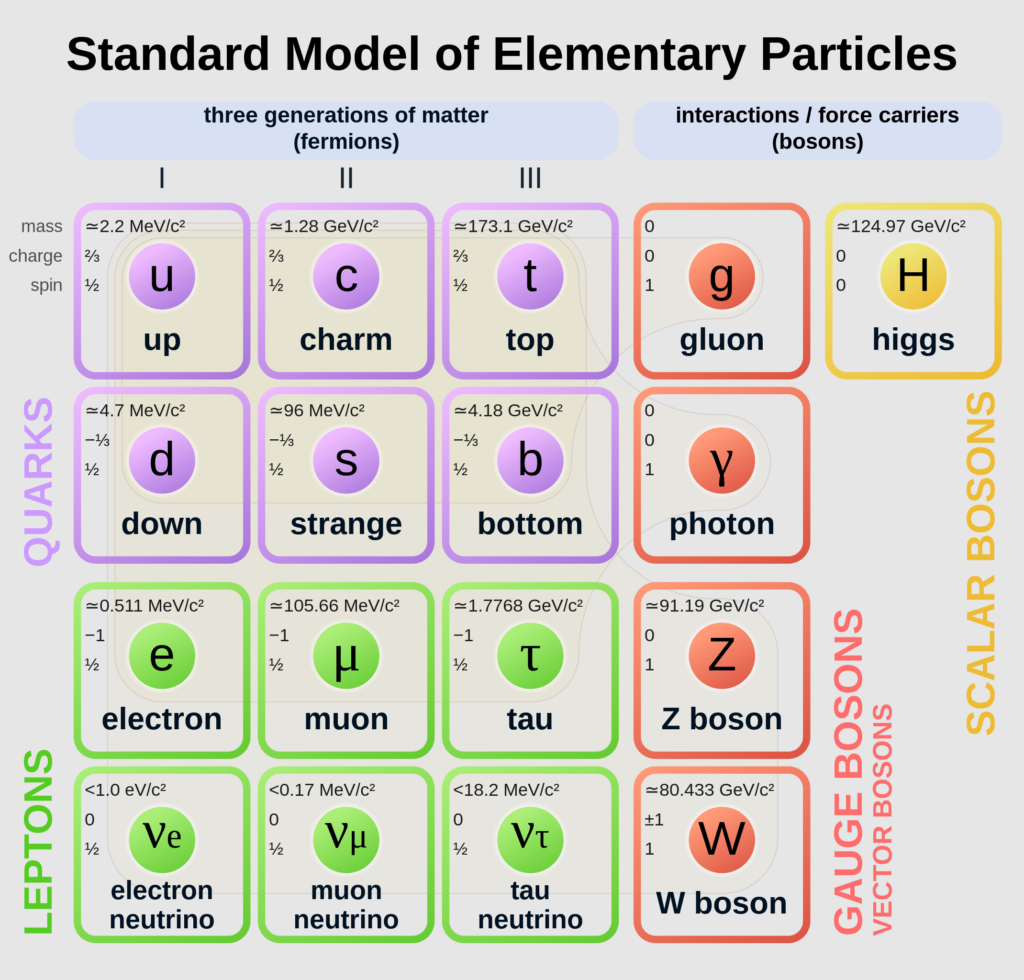
Quarks: These are the building blocks of protons and neutrons, and they come in six different varieties known as "flavors": up, down, charm, strange, top and bottom.
Leptons: These are particles that do not experience the strong nuclear force, and they include electrons, muons and tau particles, as well as their associated neutrinos.
Bosons: These are particles that mediate the fundamental forces, including the photonA particle of light. It is the particle which explains the particle-wave duality of light. It has no mass and it’s speed is the speed of light 3.00 × 10⁸ m/s (in vacuum). It is the primary energy carrier of light. The energy of a photon is dependent on the frequency. (mediates the electromagnetic force), the W and Z bosons (mediates the weak nuclear force) and the Higgs boson (which is responsible for giving particles mass). The discovery of the Higgs boson in 2012 by the Large Hadron Collider (LHC) was a major breakthrough in the field of particle physics and it confirmed the predictions of the standard model.
While the standard model has been highly successful in describing the behavior of particles at the atomic and subatomic scale, it is not a complete theory. It does not include gravity and it cannot explain the nature of dark matter and dark energy. Scientists are currently working on theories that go beyond the standard model, such as supersymmetry and extra dimensions, to try to explain these phenomena.
Continue the lesson
This section is available to learners with course access. Continue learning with Knowness to unlock the full explanation, examples, revision tools, and progress tracking.
The remaining lesson content includes further guided explanation, important learning points, and supporting interactive material designed to help you understand and revise this topic.
Unlock this topic to view the full activity, worked examples, common mistakes, and additional revision support.
More content available
Knowness lessons are structured to build understanding step by step. Create an account or upgrade your access to continue from this point.
This preview does not include the hidden lesson text, answers, explanations, or embedded interactions.
Continue learning with Knowness
Sign up to access the full lesson, predicted grades, revision tools, progress tracking, and more.
Create a free account