

General
Physics
Interference and Diffraction
Interference and diffraction are two important wave phenomena that describe how waves interact with their environment.
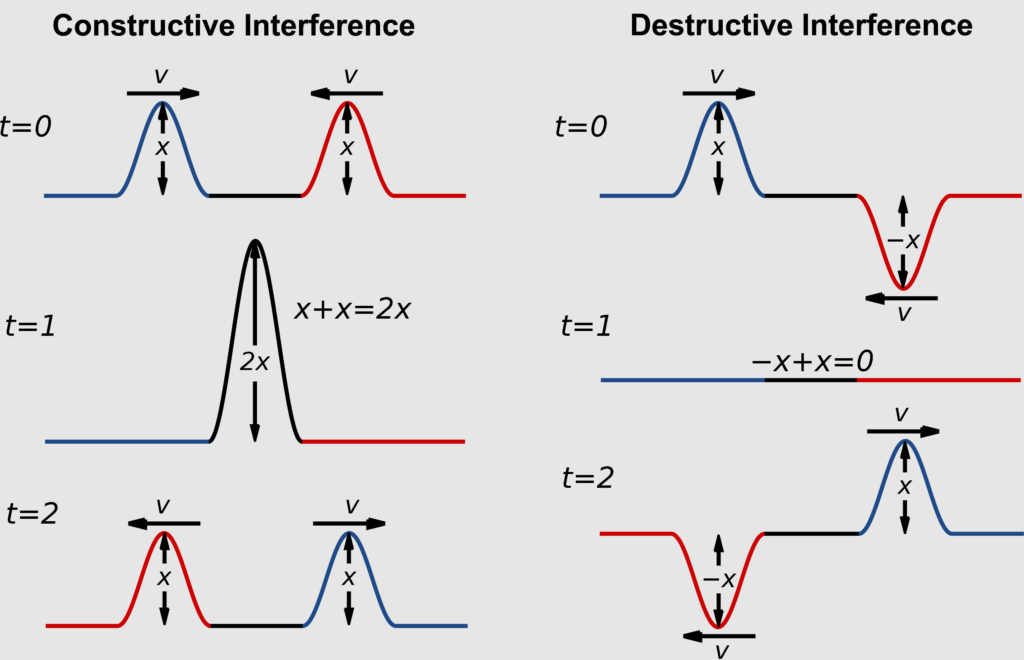
Interference is the phenomenon that occurs when two or more waves overlap and superpose to create a new wave. This means that the displacementThe forced removal of people from their land. of the resulting wave at any point is equal to the sum of the displacements of the individual waves at that point.
There are two types of interference, constructive and destructive:
Constructive interference occurs when the waves are in phase, meaning their peaks and troughs align. This results in the amplitudes of the waves adding up, creating a wave with a larger amplitude.
Destructive interference occurs when the waves are out of phase, meaning their peaks and troughs do not align. This results in the amplitudes of the waves canceling each other out, creating a wave with a smaller or zero amplitude.
Diffraction is the bending of light or other electromagnetic waves around obstacles or through narrow openings. It is a result of the wave nature of light and is observed when light passes through a small aperture or around the edge of an obstacle. The amount of diffraction that occurs depends on the size of the aperture or obstacle in relation to the wavelength of the light. The smaller the aperture or obstacle in relation to the wavelength, the more diffraction that occurs.
Continue the lesson
This section is available to learners with course access. Continue learning with Knowness to unlock the full explanation, examples, revision tools, and progress tracking.
The remaining lesson content includes further guided explanation, important learning points, and supporting interactive material designed to help you understand and revise this topic.
Unlock this topic to view the full activity, worked examples, common mistakes, and additional revision support.
More content available
Knowness lessons are structured to build understanding step by step. Create an account or upgrade your access to continue from this point.
This preview does not include the hidden lesson text, answers, explanations, or embedded interactions.
Continue learning with Knowness
Sign up to access the full lesson, predicted grades, revision tools, progress tracking, and more.
Create a free account