

2.3 The Global Weather Phenomenon Controlling the UK’s Weather
Teleconnections are large-scale patterns that exist in the atmosphere that can influence weather conditions thousands of miles away. Although they usually cause long-term, slow changes in climate they can sometimes trigger major weather events too, like the UK’s 2003 heatwave and the heavy rainfall and floods in 2014–2015.
Teleconnections and How They Affect the UK
The oceans play a major role in teleconnections. They act like giant heat batteries, storing and releasing energy that affects air temperatures and wind patterns across the planet. Changes in sea surface temperatures (SSTs) can shift atmospheric circulation, setting off powerful atmospheric waves, which move weather systems across the globe. Ocean currents, like the Gulf Stream, also carry warm water from the tropics toward the poles, helping shape climates over huge distances, including the UK’s.
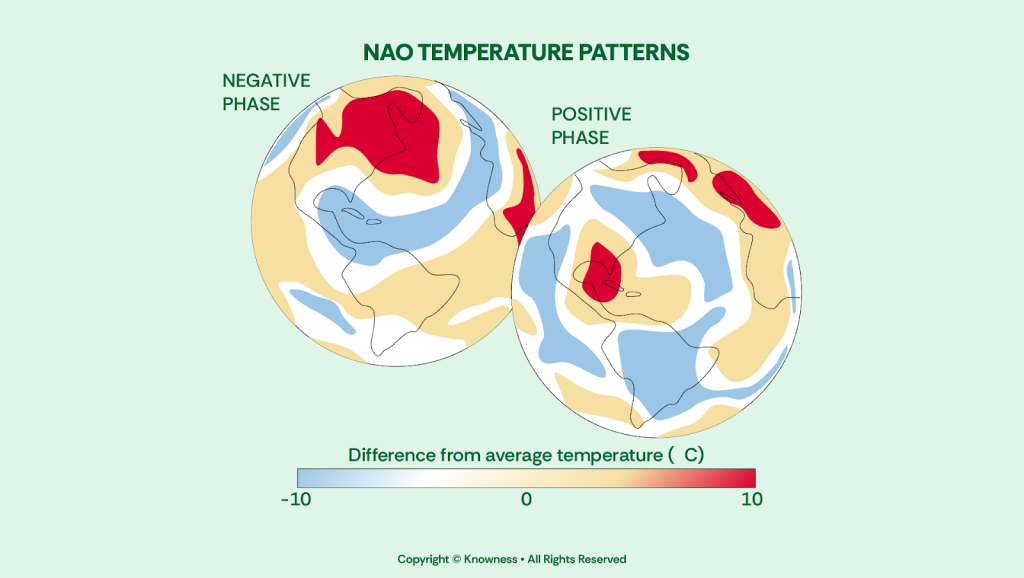
One important teleconnection for the UK is the North Atlantic Oscillation (NAO). This is based on the difference in air pressure between the Icelandic Low and the Azores High. When the NAO is in a positive phase, strong westerly winds bring the UK wetter, milder winters. In a negative phase, winters tend to be drier but colder, with more chances of snow.
Another key player in the UK’s weather conditions is the Arctic Oscillation (AO). It measures how strong the polar vortex is and how atmospheric pressure is distributed in the Arctic. A positive AO traps cold air around the North Pole, giving the UK milder winters. A negative AO allows cold Arctic air to move southward, increasing the riskThe chance that a decision could lead to loss, failure, or negative consequences. of cold snaps and snowy conditions.
There’s also the El Niño–Southern Oscillation (ENSO). ENSO is a cycle of warming (El Niño) and cooling (La Niña) in the central and eastern Pacific Ocean. Although it mostly affects places like South America, Oceania, and Southeast Asia, it has also been linked to UK weather. El Niño events have been associated with colder, drier UK winters, while La Niña tends to bring wetter, milder winters; like during the heavy flooding in 2010–2011.
There are many more teleconnections around the world, and you can explore how they affect different regions as part of your own studies!