

2.1 Just What is the Moon?
The study of the moon, Selenology, has been a focal point of interest for scientists throughout history. Then in 1973 the Apollo mission provided rock evidence that the moon was formed from an object colliding with Earth, proving that the moon was once part of Earth.
Where Did The Moon Come From?
The Giant Impact Theory suggests that the Moon was formed around 4.5 billion years ago during a cataclysmic event whereby a Mars-sized body, referred to as the Theia, collided with Earth. The sheer impact ejected massive amounts of debris into orbit around Earth, each of varying shapes and sizes, which means the debris would orbit at varying speeds. Over time, the debris coalesced through a process known as accretion to form what is now known as the moon.
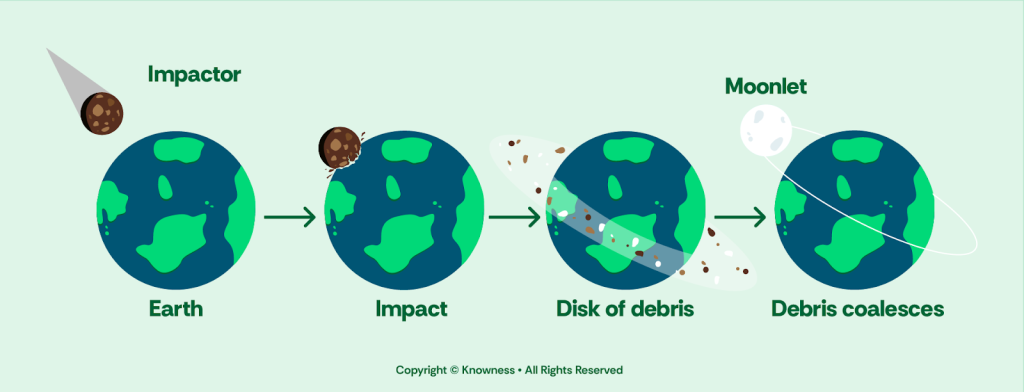
Because we have no real-time evidence of the moons’ formation process, we rely on theories and proxy variables to understand just what the moon is. A proxy variable, like lunar rocks collected during the Apollo missions in the 1970s, shows that Moon rock has similar chemical features to Earth’s mantle, ultimately supporting this Giant Impact Theory. This has also been recreated with modern day computer generation models.
However, other theories, like the Fission Theory, (which suggested that the Moon split off from Earth when it was spinning very fast), have been mostly disproved; mainly because there’s no evidence Earth ever spun that fast, and Moon rock is still slightly different from Earth’s. This theory was actually proposed by George Darwn, Charles Darwin’s son (the ‘father’ of evolution).