

2.2.3 Exchange Rates
In this lesson, we will explore how exchange rates are determined through the interaction of supply and demand, learn how to calculate currency conversions, analyse recent and historical exchange rate data, and evaluate the effects of changes in exchange rates on consumersIndividuals or households that buy and use goods and services to satisfy their needs and wants. and producersBusinesses or organisations that combine resources to produce goods and services for consumers..
Exchange Rates
An exchange rate is the price at which one currency can be exchanged for another. It represents the value of one currency in terms of another currency.
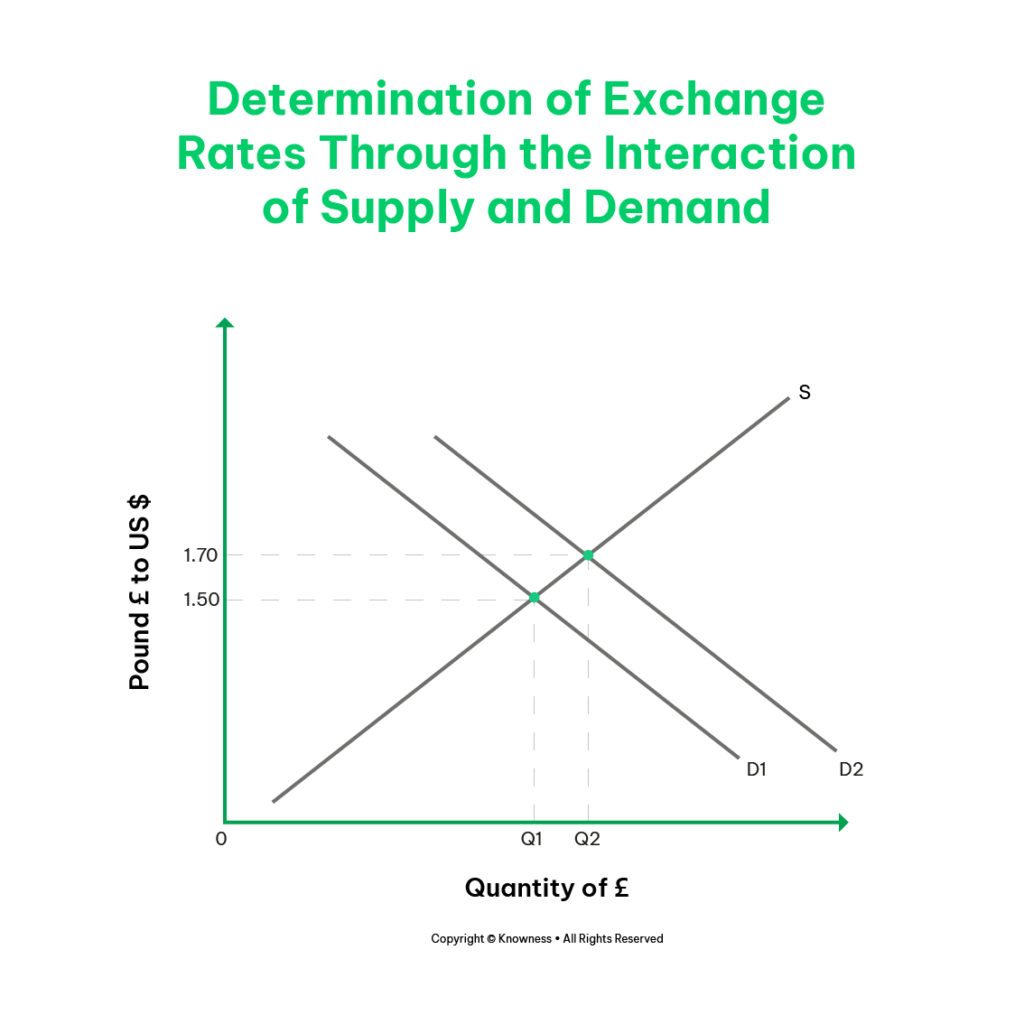
Exchange rates are determined by the interaction of supply and demand in the foreign exchange market. The factors influencing supply and demand include:
- Demand for Foreign Currency: The demand for a currency arises from individuals, businesses, and governments wanting to buy goodsPhysical, tangible products that can be touched and stored., servicesIntangible products that provide a skill, experience, or benefit rather than a physical item., or assets denominated in that currency. Factors affecting demand include imports, investment, and tourism.
- Supply of Foreign Currency: The supply of a currency comes from individuals, businesses, and governments wanting to sell goods, services, or assets denominated in that currency. Factors affecting supply include exports, foreign investments, and repatriation of profits.
Determination of Exchange Rates
- Floating Exchange Rate System: In a floating exchange rate system, exchange rates are determined by market forces of supply and demand. Governments do not intervene directly to control the value of their currency. Exchange rates under this system fluctuate freely based on market conditions.
- Fixed Exchange Rate System: In a fixed exchange rate system, governments or central banks intervene to stabilise the value of their currency against a reference currency or a basket of currencies. They actively buy or sell their own currency to maintain a predetermined exchange rate.
Calculating Currency Conversions
Exchange rates can be quoted in two ways: direct and indirect.
- Direct Exchange Rate: The direct exchange rate indicates the amount of foreign currency needed to buy one unit of the domestic currency. For example, 1 USD = 0.85 EUR means it takes 0.85 euros to buy one US dollar.
- Indirect Exchange Rate: The indirect exchange rate indicates the amount of domestic currency needed to buy one unit of the foreign currency. Using the above example, the indirect exchange rate would be 1 EUR = 1.18 USD.
To convert from one currency to another, you multiply the amount in the original currency by the applicable exchange rate. For example, to convert 100 euros to US dollars with an exchange rate of 1 EUR = 1.18 USD, you would multiply 100 euros by 1.18 to get 118 US dollars.
Analysis of Exchange Rate Data
Analysing exchange rate data helps us understand trends, patterns, and fluctuations in currency values. Factors such as economic indicators, interest rates, political stability, and market sentiment influence exchange rates. By studying historical data, we can identify long-term trends and make informed predictions about future currency movements.
Impact of Exchange Rate Changes on Consumers and Producers
Consumers:
- Importers and Travellers: A stronger domestic currency makes imported goods and foreign travel more affordable. Conversely, a weaker domestic currency increases the cost of imports and foreign travel.
- Inflation: Changes in exchange rates can affect inflation. A weaker currency may lead to higher import prices, potentially causing inflationary pressures.
Producers:
- Exporters: A weaker domestic currency can make exports more competitive and increase export revenues. Conversely, a stronger domestic currency may make exports more expensive for foreign buyers.
- Import-Dependent Industries: Industries that rely heavily on imports for raw materials or components may face higher costsThe sacrifices made when choosing a particular option, which may include money spent, time used, or resources consumed. with a weaker currency.
- Global Competitiveness: Exchange rate fluctuations can impact a country's overall competitiveness in international markets.
Conclusion
Exchange rates are determined by the interaction of supply and demand in the foreign exchange market. Currency conversions involve calculating the value of one currency in terms of another. Analysing exchange rate data allows us to identify trends and evaluate the effects of exchange rate changes on consumers and producers.