

1.1.2 The Basic Economic Problem
In this lesson, you will learn about the basic economic problemThe problem of allocating scarce resources to satisfy unlimited human wants., which arises because resourcesThe inputs used to produce goods and services, including the factors of production. are limited but human wants are unlimited. You will explore scarcityThe situation where limited resources are not sufficient to satisfy unlimited human wants., the key questions economies must answer about production, the concept of opportunity costThe value of the next best alternative that is forgone when a decision is made., and how costsThe sacrifices made when choosing a particular option, which may include money spent, time used, or resources consumed. and benefits are considered when making economic decisions.
Scarce Resources and Unlimited Wants
The basic economic problem exists because resources are scarce but human wants are unlimited.
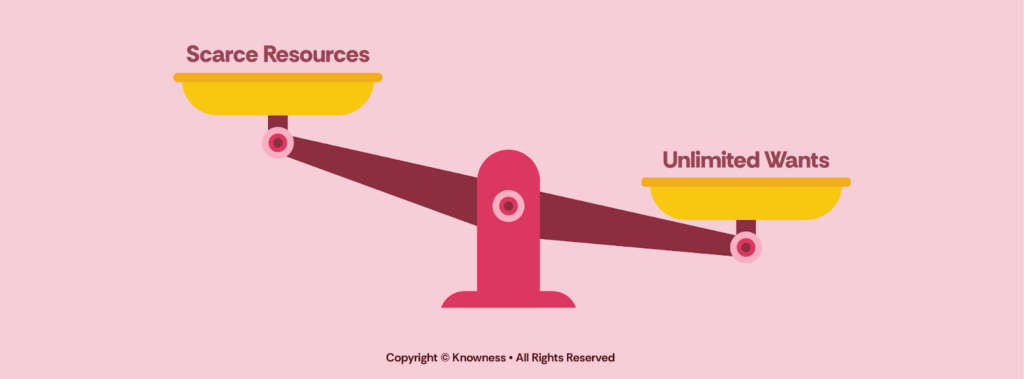
Resources are the inputs used to produce goods and services. These include the factors of productionThe resources used to produce goods and services, including land, labour, capital, and enterprise. such as landAll natural resources used in production, including soil, water, forests, minerals, oil, and other resources from nature., labourThe human effort used in production, including both physical and mental work as well as workers’ skills and knowledge., capitalThe man-made resources used to produce goods and services, such as machinery, tools, computers, and buildings., and enterpriseThe ability to organise the other factors of production and take risks in order to start and run a business.. However, these resources are limited in supply. Because there are not enough resources to produce everything people want, choices must be made about how resources are used. This situation is known as scarcity. Scarcity means that there are limited resources available to meet unlimited wantsThe idea that human desires for goods and services are continually growing and cannot be fully satisfied..
Scarcity does not mean that something is rare. A product can be widely available but still be scarce if there are not enough resources to produce unlimited quantities of it.Note
While resources are limited, human wants are virtually unlimited. People constantly want more goods and services to improve their quality of life. Some wants are basic necessities such as food, water, and shelter. Others are comforts or luxuries such as new phones, holidays, or entertainment.
As societies become wealthier, new wants often appear. For example, many products that people now see as essential, such as smartphones or streaming services, did not exist a few decades ago. Because wants continue to grow while resources remain limited, societies must decide how to use their scarce resources carefully.
The Economic Problem
The economic problem refers to the challenge of allocating scarce resources to satisfy unlimited wants. Since it is impossible to produce everything people want, choices must be made about what goods and services should be produced and how resources should be used. Every economyA system in which consumers, producers, and government interact to produce, distribute, and consume goods and services. must answer three key questions: what to produce, how to produce, and for whom to produce.
What to Produce
Societies must decide which goods and services should be produced and how many of them should be made. For example, resources could be used to produce more hospitals, more schools, more cars, or more entertainment services. Because resources are limited, producing more of one thing often means producing less of something else. These decisions are often influenced by factors such as consumer demand, governmentThe public authority that provides services, collects taxes, sets laws and regulations, and helps manage the economy. priorities, and available resources.
How to Produce
Economies must also decide how goods and services should be produced. This includes deciding which methods of production to use and which combination of factors of production should be used. Businesses may choose between using more labour or more machinery depending on which is more efficient and cost-effective. For example, a factory may choose to automate production using machines, while another business may rely more heavily on workers.
For Whom to Produce
Finally, societies must decide who will receive the goods and services that are produced. This question relates to the distribution of income and wealth. Individuals with higher incomes are usually able to buy more goods and services, while those with lower incomes may have fewer choices. Governments sometimes intervene to influence distribution by providing public services, welfare benefits, or subsidies.
Opportunity Cost
Whenever a choice is made, an alternative option must be given up. The opportunity cost of a decision is the value of the next best alternative that is forgone. Opportunity cost exists because resources are scarce. Since resources can only be used for one purpose at a time, choosing one option means sacrificing another.
To illustrate opportunity cost, consider a student who has limited time and must decide between studying for an exam or going to a social event. If they choose to attend the event, the opportunity cost is the potential benefitThe gain or advantage received from making a particular economic decision. they could have gained from studying. If the student chooses to study instead, the opportunity cost is the enjoyment of the social event. By choosing one option, the student foregoes the benefits of the other option.
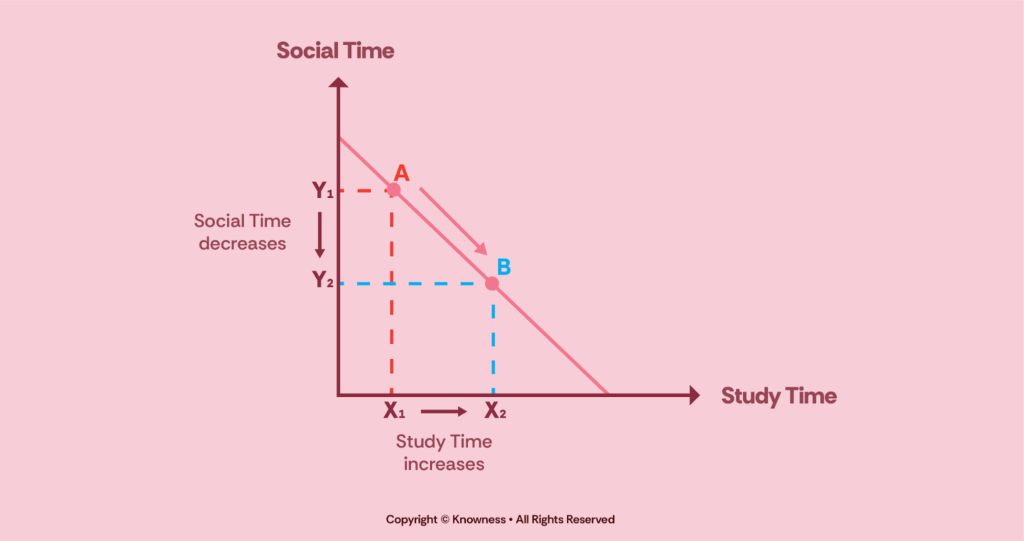
In Figure 2 above, moving from point A to point B means the student chooses more study time (from \(X_1\) to \(X_2\)), but this can only happen by giving up some social time. The social time that is given up (from \(Y_1\) to \(Y_2\)) is the opportunity cost of studying more. Likewise, choosing more social time means sacrificing study time. The curve therefore shows that because time is scarce, gaining more of one option means giving up some of another.
Opportunity cost also applies to governments and businesses. For instance, if a government decides to spend more money on healthcare, it may have less money available to spend on transport or education.
Evaluation of Costs and Benefits
When making economic decisions, individuals, businesses, and governments often compare costs and benefits. Costs are the sacrifices made when choosing a particular option; these may include money spent, time used, or resources consumed. Benefits are the gains or advantages received from making that choice.
Economists often describe decision-making as weighing costs against benefits. A decision is usually considered worthwhile if the benefits are greater than the costs. Good economic decision-making involves comparing the costs and benefits of different options to choose the one that provides the greatest overall benefit. Note
When evaluating economic decisions, it is also important to consider their impact on sustainabilityThe principle of meeting present needs without preventing future generations from meeting their own needs.. Sustainability involves ensuring that economic activities meet present needs without preventing future generations from meeting their own needs. This means considering the long-term effects of economic decisions, not just the immediate benefits.
There are three main dimensions of sustainability, which are often considered together when evaluating economic choices. These are economic, social, and environmental sustainability.
| Dimension | Explanation |
|---|---|
| Economic SustainabilityThe ability of an economy to maintain stable economic growth and use resources efficiently over time. | Maintaining stable economic growth over time. This means using resources efficiently so that economies can continue producing goods and services in the future. |
| Social SustainabilityThe ability to support the well-being and quality of life of individuals and communities over time. | Supporting the well-being of individuals and communities. This includes fair access to resources, good working conditions, and improved quality of life. |
| Environmental SustainabilityThe protection and conservation of natural resources and ecosystems so that they remain available for future generations. | Protecting the natural environment and conserving resources such as forests, water, and wildlife so they remain available for future generations. |
Governments, businesses, and individuals must often balance these different considerations when making economic choices. Sometimes a decision may bring economic benefits but create environmental costs, or it may improve social well-being but increase financial costs.