

General
Economics
Price Determination
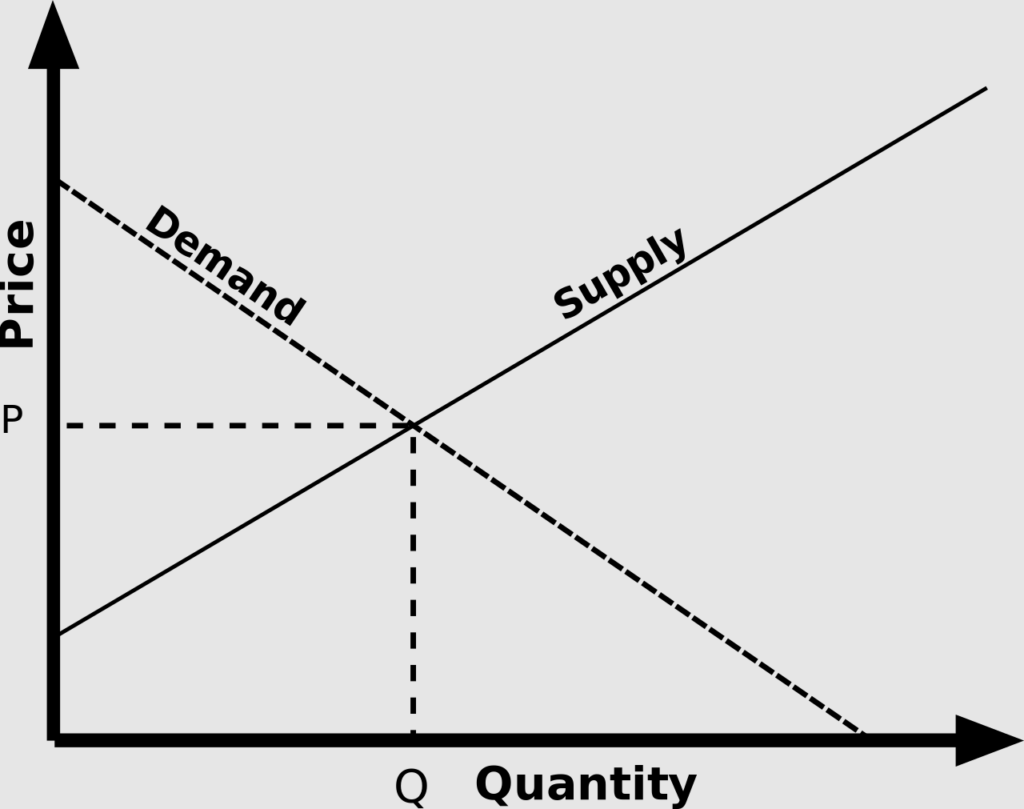
Price determination is the process of determining the final price at which a good or service is sold in a market. The price of a good or service is determined by the interaction between the supply and demand for that good or service in a market. The supply and demand curves represent the quantity of a good or service that buyers and sellers are willing to buy and sell at different prices.
This file is licensed under the Creative Commons Attribution-Share Alike 3.0 Unported license.
In a perfectly competitive market, the price is determined by the market, meaning that the price is the point where the quantity demanded by buyers equals the quantity supplied by sellers. In a perfectly competitive market, firms are price takers, which means that they have no control over the price and must accept the price that the market sets.
In monopolistic competition and oligopoly, firms have some ability to set prices, but they must consider the elasticity of demand for their product. Elasticity of demand measures how responsive the quantity demanded is to a change in price. If demand is elastic, a small change in price will result in a large change in the quantity demanded. In this case, firms will have to be careful when setting prices as a small increase in price may result in a large decrease in the quantity demanded. On the other hand, if demand is inelastic, a small change in price will result in a small change in the quantity demanded. In this case, firms will have more leeway in setting prices.
In a monopoly, a firm has complete market power and can set the price of the product without considering the market demand. The firm is the sole supplier of the product and has complete control over the price. This means that the firm can set the price at any level it chooses, as long as it is profitable.
Understanding the different market structures and how prices are determined in each can help one better understand the behavior of firms in different industries and make predictions about how they will respond to changes in the market.
Continue the lesson
This section is available to learners with course access. Continue learning with Knowness to unlock the full explanation, examples, revision tools, and progress tracking.
The remaining lesson content includes further guided explanation, important learning points, and supporting interactive material designed to help you understand and revise this topic.
Unlock this topic to view the full activity, worked examples, common mistakes, and additional revision support.
More content available
Knowness lessons are structured to build understanding step by step. Create an account or upgrade your access to continue from this point.
This preview does not include the hidden lesson text, answers, explanations, or embedded interactions.
Continue learning with Knowness
Sign up to access the full lesson, predicted grades, revision tools, progress tracking, and more.
Create a free account