

General
Economics
Production Possibilities Frontier, Opportunity Cost and Trade-Offs
The production possibilities frontierThe edge of settled territory, beyond which lies unsettled or unfamiliar land. (PPF) is a graphical representation of the different combinations of goodsPhysical, tangible products that can be touched and stored. and servicesIntangible products that provide a skill, experience, or benefit rather than a physical item. that an economyA system in which consumers, producers, and government interact to produce, distribute, and consume goods and services. can produce given its available resourcesThe inputs used to produce goods and services, including the factors of production. and technology. It shows the maximum combinations of two products that can be produced within the given resources and technology. The PPF is a straight line when plotted on a graph, with the two products on the x-axis and y-axis, respectively.
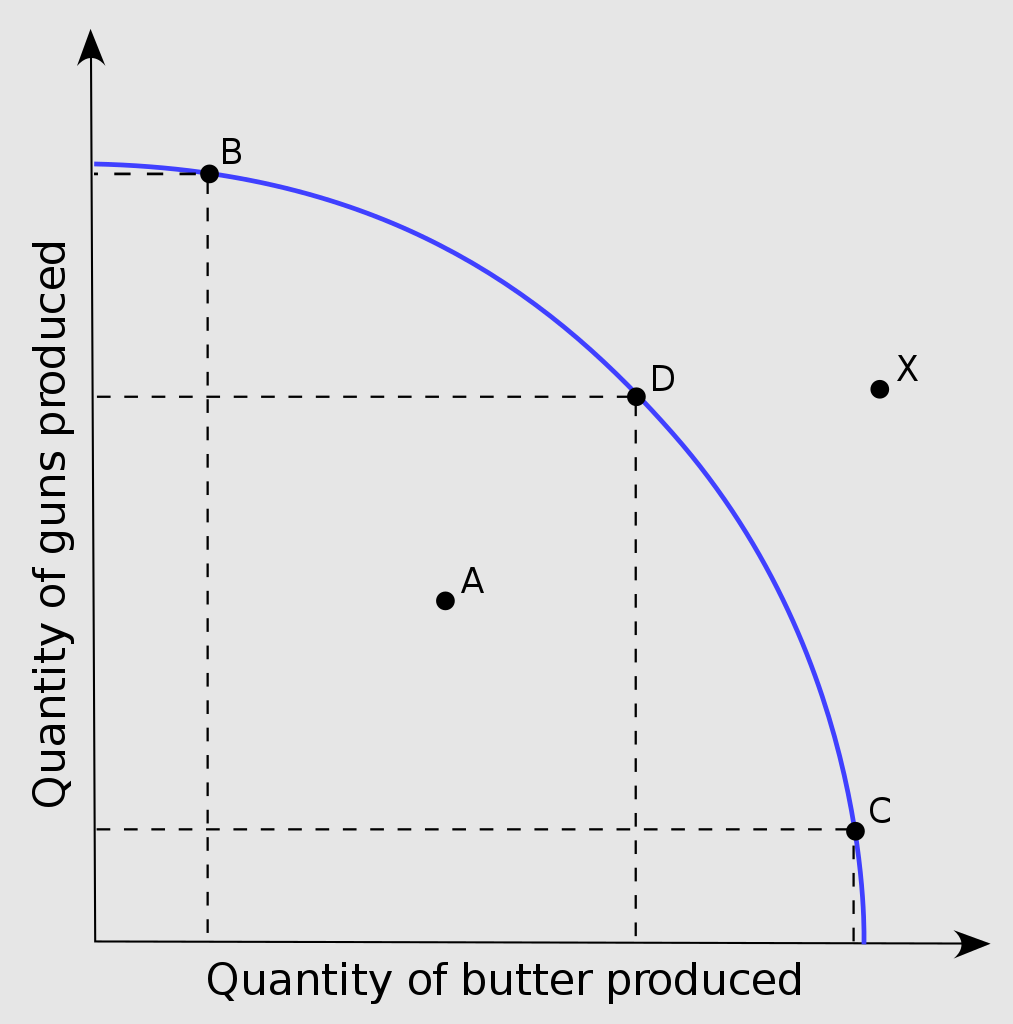
This file is licensed under the Creative Commons Attribution-Share Alike 3.0 Unported license.
Points on the PPF represent efficient combinations of production, meaning that all available resources are being used to produce the two products. Points inside the PPF are inefficient, as resources are not being fully utilized. Points outside the PPF are unattainable, as they exceed the economy's current resources and technology.
The slope of the PPF represents the opportunity costThe value of the next best alternative that is forgone when a decision is made. of producing one good in terms of the other. OpportunityA gap in the market or a new idea that a business can use to meet customer needs and make a profit. cost is the cost of one opportunity in terms of the next best alternative opportunity. It is the cost of the foregone opportunity or the alternative that is given up. The steeper the slope, the greater the opportunity cost of producing one good. For example, if the slope is steep, it means that producing more of one good will require a large sacrifice of the other good. Every economic decision involves trade-offs, which are the opportunities that are given up in favor of another.
For example, if a person chooses to go to college, they will have to give up the opportunity to work and earn money during that time. The opportunity cost of going to college is the foregone earnings. Similarly, if a business decides to invest in a new machine, the opportunity cost is the foregone investment in another project or the lost opportunity to use that money in another way.
The PPF also illustrates the concept of trade-offs that society faces in allocating resources between different goods and services. A society can choose to produce more of one good, but it will have to give up some of the other good. The PPF represents the trade-offs that an economy has to make between two goods.
Continue the lesson
This section is available to learners with course access. Continue learning with Knowness to unlock the full explanation, examples, revision tools, and progress tracking.
The remaining lesson content includes further guided explanation, important learning points, and supporting interactive material designed to help you understand and revise this topic.
Unlock this topic to view the full activity, worked examples, common mistakes, and additional revision support.
More content available
Knowness lessons are structured to build understanding step by step. Create an account or upgrade your access to continue from this point.
This preview does not include the hidden lesson text, answers, explanations, or embedded interactions.
Continue learning with Knowness
Sign up to access the full lesson, predicted grades, revision tools, progress tracking, and more.
Create a free account