

General
Astronomy
-
1. Introduction to Astronomy
-
Introduction to Astronomy
-
History of Astronomy
-
Fundamentals of Astronomy
-
The Solar System
-
The Moon and Planetary Science
-
Stars and Stellar Evolution
-
Galaxies and the Universe
-
Cosmology and the Early Universe
-
Observing the Sky
-
Future of Astronomy
-
Careers in Astronomy
Legacy Course
The Structure of the Universe
The structureThe organisation and order of information in a text. of the universe is one of the fundamental questions in cosmologyThe study of the origins and structure of the universe., and the study of the large-scale structure of the universe is an important area of research. One of the key concepts in this field is the cosmic web, which describes the arrangement of galaxies and other large-scale structures in the universe.
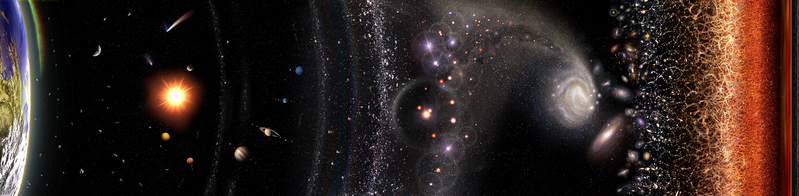
This file is licensed under the Creative Commons Attribution-Share Alike 4.0 International license.
The cosmic web is composed of a network of filaments and sheets that connect dense regions of matter, such as galaxy clusters and superclusters, while large voids are regions of space that contain very little matter. The distribution of matter in the universe is not homogeneous, but rather it forms a complex web-like structure. This structure is created through the process of gravitational collapse, where small density perturbations in the early universe grow and eventually form the large-scale structure observed today.
Dark matter and dark energy play a crucial role in shaping the structure of the universe. Dark matter is a form of matter that does not interact with electromagnetic radiation and therefore cannot be directly observed. However, it is thought to make up about 85% of the total mass-energy of the universe, and it plays a key role in the formation of galaxy clusters, superclusters and other large scale structures. Dark energy, on the other hand, is a mysterious form of energy that is thought to be responsible for the accelerated expansion of the universe. It is postulated that dark energy makes up about 70% of the universe's total mass-energy, and it is the dominant force in shaping the structure of the universe on large scales.
Galaxy clusters, superclusters, and voids are key tools used to study the large-scale structure of the universe. Galaxy clusters are large concentrations of galaxies that are held together by gravity. They are the most massive known structures in the universe and provide important information about the properties of dark matter. Superclusters are even larger structures that consist of many galaxy clusters and other large-scale structures. Voids, on the other hand, are large regions of space that contain very few galaxies and other structures, and they provide important information about the properties of dark energy. The study of galaxy clusters, superclusters and voids, can provide important insight into the properties of dark matter and dark energy and how they shape the large-scale structure of the universe.
Continue the lesson
This section is available to learners with course access. Continue learning with Knowness to unlock the full explanation, examples, revision tools, and progress tracking.
The remaining lesson content includes further guided explanation, important learning points, and supporting interactive material designed to help you understand and revise this topic.
Unlock this topic to view the full activity, worked examples, common mistakes, and additional revision support.
More content available
Knowness lessons are structured to build understanding step by step. Create an account or upgrade your access to continue from this point.
This preview does not include the hidden lesson text, answers, explanations, or embedded interactions.
Continue learning with Knowness
Sign up to access the full lesson, predicted grades, revision tools, progress tracking, and more.
Create a free account