

1.1.1 Main Economic Groups and Factors of Production
In this lesson, you will learn about the three main economic groups in an economyA system in which consumers, producers, and government interact to produce, distribute, and consume goods and services.: consumersIndividuals or households that buy and use goods and services to satisfy their needs and wants., producersBusinesses or organisations that combine resources to produce goods and services for consumers., and governmentThe public authority that provides services, collects taxes, sets laws and regulations, and helps manage the economy., and how they interact. You will also explore the four factors of productionThe resources used to produce goods and services, including land, labour, capital, and enterprise.: landAll natural resources used in production, including soil, water, forests, minerals, oil, and other resources from nature., labourThe human effort used in production, including both physical and mental work as well as workers’ skills and knowledge., capitalThe man-made resources used to produce goods and services, such as machinery, tools, computers, and buildings., and enterpriseThe ability to organise the other factors of production and take risks in order to start and run a business., which are the resourcesThe inputs used to produce goods and services, including the factors of production. used to produce goods and services.
Main Economic Groups
An economy is made up of different groups that interact with each other through the production and consumption of goods and services. The three main economic groups are consumers, producers, and government. Each group performs a different role, but they depend on each other for the economy to function effectively.

Consumers
Consumers are individuals or households that buy and use goods and services to satisfy their needs and wants; the nature of these needs and wants are covered in depth in Lesson 1.1.2 The Basic Economic ProblemThe problem of allocating scarce resources to satisfy unlimited human wants.. Consumers are important because their spending decisions influence what businesses choose to produce. If demand for a product rises, businesses are likely to produce more of it. If demand falls, businesses may reduce production or stop making that product altogether.
Consumers don’t just affect markets by buying products. Their tastes, habits, and priorities also influence the types of goods and services businesses develop. A growing interest in healthier lifestyles, for instance, may encourage firms to sell healthier foods or promote gym memberships.
Producers
Producers, also called firms or businesses, are organisations that make and supply goods and services. Producers combine resources to create the products that consumers want. Most producers aim to satisfy consumer demand while also making a profitThe difference between the total revenue a business receives from sales and its total costs of production.. Profit is the difference between the money a business receives from sales and the costsThe sacrifices made when choosing a particular option, which may include money spent, time used, or resources consumed. of production. A bakery, a phone manufacturer, and a streaming platform are all examples of producers.
Producers must respond to changes in consumer demand. If they produce goods that people no longer want, they may struggle to sell their output and could make a loss.
Government
The government also plays an important role in the economy. It provides public services such as healthcare, education, and policing. It also collects taxes, creates laws, and sets rules that businesses and consumers must follow.
Governments try to make the economy work more smoothly. They may support fairness, protect consumers, reduce harmful behaviour, and provide services that private firms may not provide on their own. For example, the government may place taxes on cigarettes, introduce safety regulations for businesses, or spend money on state schools and hospitals.
The three main economic groups are interdependent, which means they depend on each other. This interdependenceThe situation where different economic groups depend on each other through production, spending, taxation, and services. is illustrated below in Figure 2. Consumers buy goods and services from producers. Producers employ workers and pay wages to households for their labour, which gives consumers income to spend. Both consumers and producers pay taxes to the government, and the government uses this money to provide services and maintain the legal system through regulation.
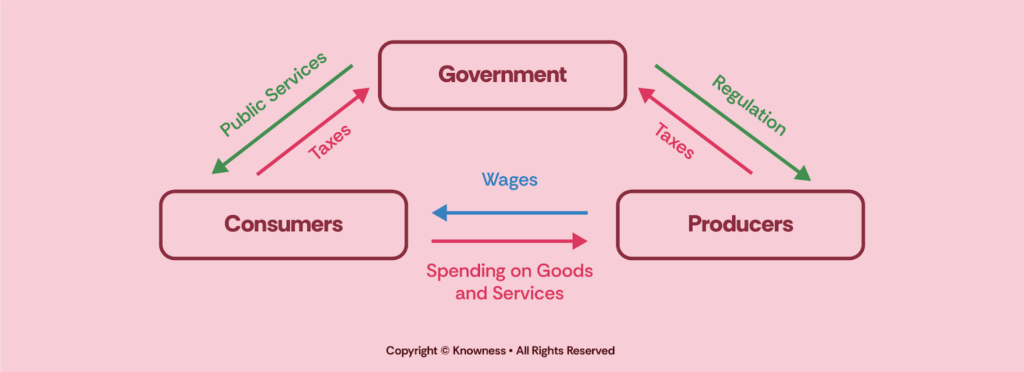
This means the economy is not made up of separate parts working alone. Instead, consumers, producers, and government are all connected through spending, production, taxation, and services. These interactions demonstrate how the economy functions through continuous flows of money and resources between the three main economic groups.
Factors of Production
To produce goods and services, businesses need resources. These resources are called the factors of production. There are four main factors of production: land, labour, capital, and enterprise. Businesses combine these four factors in different ways depending on what they are producing. A farm, a factory, and a shop all need these factors, but they use them in different proportions.
Land
In economics, land means all natural resources used in production. It does not just mean a piece of ground. It includes farmland, forests, rivers, oil, gas, minerals, and other resources that come from nature.
Land is important because it provides the raw materials needed to make many goods and services. Farmers use soil and water to grow crops. Mining companies extract minerals from the earth. Energy firms use natural resources such as oil, gas, or wind to generate power.
Labour
Labour is the human effort used in production. It includes both physical work and mental work. Labour also includes the skills, knowledge, training, and experience that workers bring to their jobs.
Workers in different jobs provide different types of labour. Builders use physical effort and practical skills. Teachers use knowledge and communication skills. Engineers use technical knowledge to design and improve products.
Labour can be skilled or unskilled. Skilled labour involves workers with training or qualifications, such as doctors or electricians. Unskilled labour involves work that needs less specialist training. In all cases, labour is essential because workers help turn resources into finished goods and services.
Capital
Capital refers to the man-made resources used to produce other goods and services. This includes items such as machines, tools, computers, delivery vans, and factory buildings.
Capital is important because it helps workers produce more efficiently. For example, a farmer using a tractor can produce more than a farmer using only hand tools. A business with modern machinery can often produce output more quickly and at a lower cost than one using outdated equipment.
In economics, capital does not simply mean money. It means the tools, machinery, and equipment used in production. Money is used to buy capital, but money itself is not usually classed as a factor of production.Note
Enterprise
Enterprise is the ability to organise the other factors of production and take the risks involved in starting or running a business. The person who provides enterprise is the entrepreneurA person who organises the factors of production and takes risks to start or manage a business..
Entrepreneurs make decisions about what to produce, how to produce it, and how to combine land, labour, and capital. They also take financial risks because a business may succeed and make profit, or fail and make losses.
Enterprise is important because without someone to organise the other factors, production would not happen effectively. Entrepreneurs often introduce new ideas, spot business opportunities, and take decisions that help firms grow.
The four factors of production work together to produce goods and services. For example, a car manufacturer needs land for raw materials such as metal and rubber, labour from workers and engineers, capital such as machinery and factory equipment, and enterprise to organise the business and take decisions.
The exact combination of factors will depend on the type of business. A farm may use large amounts of land, while a software company may depend more heavily on skilled labour and enterprise. However, all production relies on these four factors in some form.
When the factors of production are used efficiently, businesses can produce more output and improve productivity. This helps firms grow and contributes to economic growth in the wider economy.