

General
Mechanical Engineering
-
Introduction to Mechanical Engineering
-
History of Mechanical Engineering
-
Mechanics
-
Materials Science
-
Statics
-
Dynamics
-
Strength of Materials
-
Fluid Mechanics
-
Heat Transfer
-
Thermodynamics
-
Manufacturing and Machining
-
Mechatronics
-
Future of Mechanical Engineering
-
Careers in Mechanical Engineering
Legacy Course
Stress and Strain in Materials
Strength of materials, also known as mechanics of materials, is the study of the behavior of materials under load. It is an important field in mechanical engineering, as it is essential for understanding the behavior of materials and designing structures and machines that can withstand loads and forces.
When a material is subjected to a load, it undergoes deformation, which is a change in shape or size. The deformation of a material is characterized by two important parameters, stress and strain. Stress is the force per unit area acting on a material, and it is a measure of the internal forces within the material. It is a measure of the amount of force acting on a unit area of the material. Stress is represented mathematically as the ratio of the applied force to the cross-sectional area of the material and is measured in units of pressure such as Pa or psi.
Strain is the deformation of a material per unit length, and it is a measure of the response of the material to the applied load. It is a dimensionless parameter and is calculated as the ratio of the change in length to the original length.
The relationship between stress and strain is described by the elastic behavior of the material, which is governed by Hooke's Law. This law states that the strain of a material is proportional to the applied stress, and the proportionality constant is called the Young's modulus, which is a measure of the stiffness of the material. In other words, Hooke's Law states that the strain is directly proportional to the stress, with the proportionality factor being the Young's modulus.
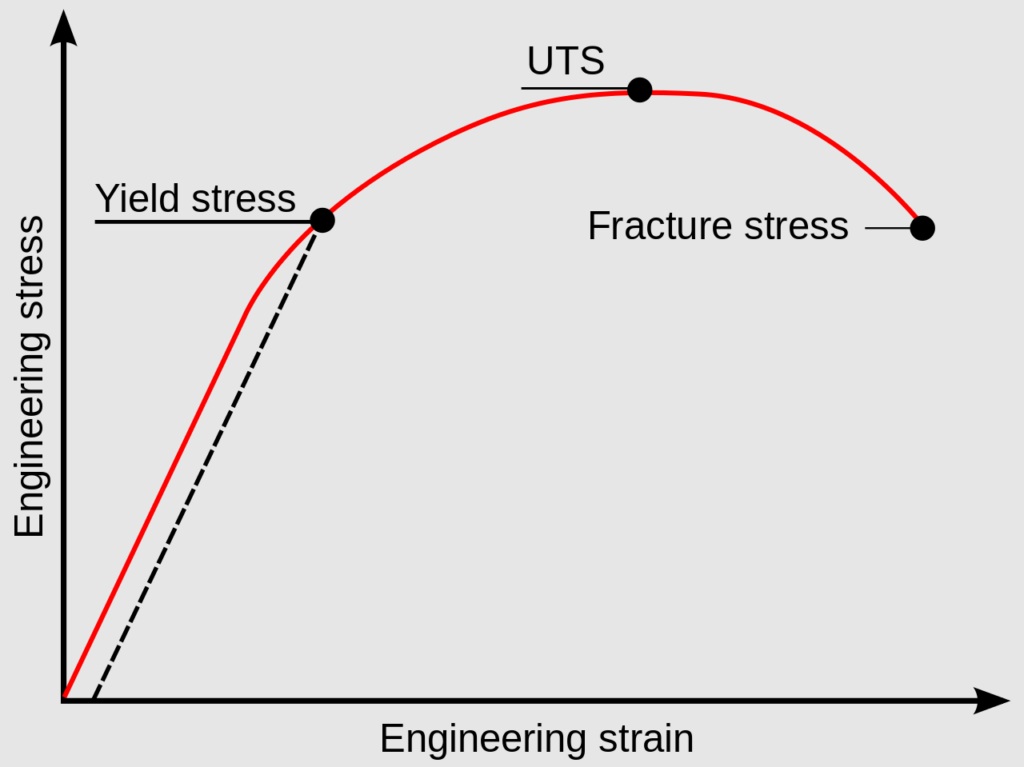
The elastic behavior of a material is limited, and materials will eventually yield or break under excessive loads. The point at which a material yields is called the yield stress, and the point at which a material breaks is called the ultimate strength. The ratio of the ultimate strength to the yield stress is called the factor of safety and is used to ensure that a material will not fail under normal loads.
Continue the lesson
This section is available to learners with course access. Continue learning with Knowness to unlock the full explanation, examples, revision tools, and progress tracking.
The remaining lesson content includes further guided explanation, important learning points, and supporting interactive material designed to help you understand and revise this topic.
Unlock this topic to view the full activity, worked examples, common mistakes, and additional revision support.
More content available
Knowness lessons are structured to build understanding step by step. Create an account or upgrade your access to continue from this point.
This preview does not include the hidden lesson text, answers, explanations, or embedded interactions.
Continue learning with Knowness
Sign up to access the full lesson, predicted grades, revision tools, progress tracking, and more.
Create a free account