

1.1.6 Tropical Storms
In this lesson, we will explore the global distribution of tropical storms, the relationship between these storms and general atmospheric circulation, the causes of their formation and development, the structure and features of a tropical storm, and the potential impact of climate change on their distribution, frequency, and intensity.
Global Distribution of Tropical Storms
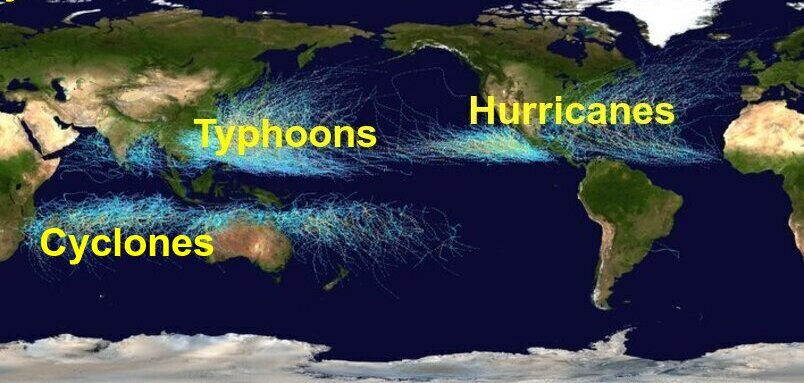
Tropical storms occur in specific regions around the world, predominantly in the tropical and less so the subtropical areas of the Earth. They have different names depending on the region:
- Hurricanes: Atlantic Ocean and eastern Pacific Ocean.
- Cyclones: Indian Ocean and South Pacific Ocean.
- Typhoons: Northwest Pacific Ocean.
Relationship Between Tropical Storms and General Atmospheric Circulation
Global atmospheric circulation has a significant influence on the occurrence and characteristics of weather hazards. The movement and interaction of air masses along the pressure belts and surface winds contribute to the formation of specific weather patterns, including storms, heatwaves, and precipitation events.
Key elements of this relationship include:
- The Intertropical Convergence Zone (ITCZ) on the general atmospheric model describes how uneven solar heating provides enough heat to ocean waters, subsequently rising warm air, leading to thunderstorms, strong winds, and heavy rainfall. These conditions can fuel tropical storms.
- The sub-tropical zone, although with cooler ocean temperatures, there is less wind shear. In this zone, the warm tropical weather interacts with the cold front, creating atmospheric instability.
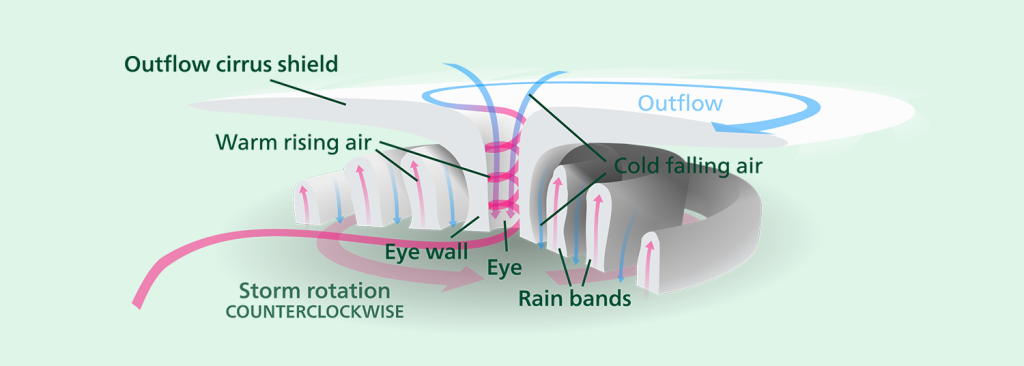
- The coriolis effect, caused by Earth’s rotation, deflects moving air. It causes air to spiral counterclockwise in the northern-hemisphere and a clockwise rotation in the southern-hemisphere. This effect is vital for forming the rotating tropical cyclones.
- Trade winds can steer tropical storms westward and contribute to their poleward movement as they interact with other atmospheric circulation patterns.
- Low wind shear (the difference in wind speed and direction with height), can determine the vertical development of storms, either preventing them from maturing them into a tropical cyclone.
Overall, tropical storms form around 5 to 20 degrees north and south of the equator (the tropical region), as this is where the ocean is warm due to the angle of the sun’s energy.
Mid-Latitude Weather Systems
Low-pressure systems, known as extratropical cyclones, develop along the polar front where warm and cold air masses meet at around 60° North and South of the equator.
The prevailing westerlies play a crucial role in steering and intensifying these weather systems. This is important in creating the UK’s weather.
Causes and Formation of Tropical Storms
Tropical storms only form in certain areas around the world. This is because there are conditions that need to be met by the environment to initialise the generation of a tropical storm, these are:
- Warm, deep ocean waters (typically above 26.5°C or 80°F) provide the necessary heat and moisture.
- A pre-existing disturbance, such as a tropical wave or an area of low pressure, serves as a focus for storm development.
- Minimal vertical wind shear (change in wind speed or direction with height) allows the storm to organise and grow vertically.
Formation and Development
As warm ocean waters evaporate, moisture-laden air rises rapidly, creating low-pressure conditions at the surface. The rising air spirals upward due to the coriolis effect, resulting in the formation of a rotating system. The rotating system continues to strengthen as it draws in more heat and moisture from the ocean’s surface. When the sustained wind speeds reach 74 mph (119 km/h), the system is classified as a tropical storm.
Structure and Features of a Tropical Storm
Tropical storms act in a unique way, this is because of their distinct structure and features.
Eye
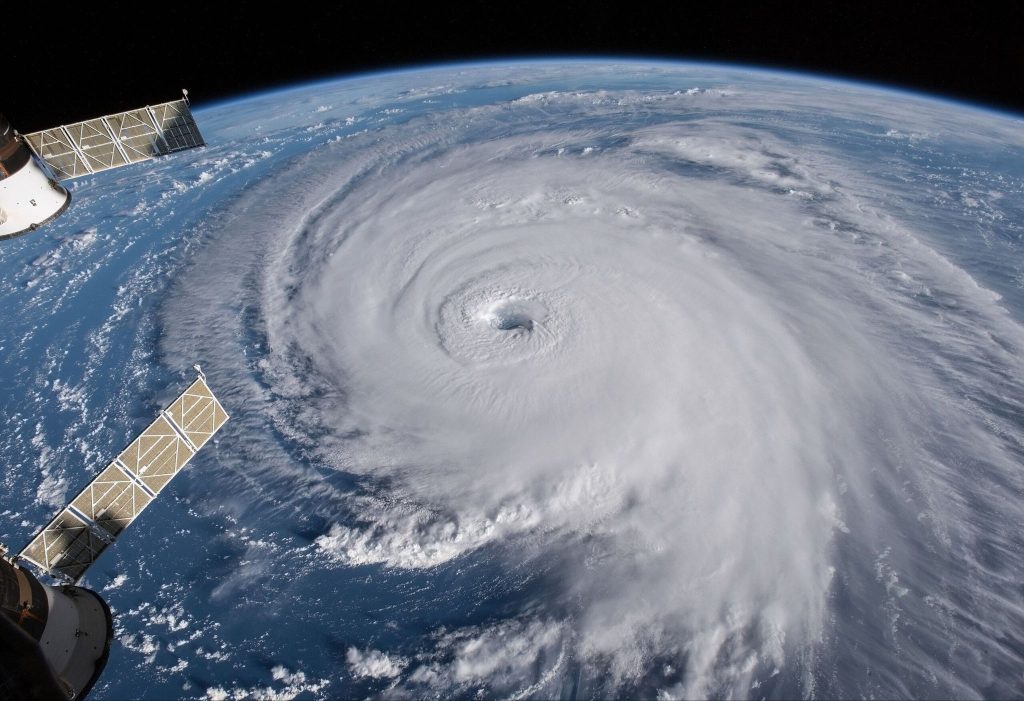
At the centre of a mature tropical storm is a relatively calm and clear area called the eye. The eye is surrounded by a circular wall of towering thunderstorms known as the eyewall, where the strongest winds and heaviest rainfall occur.
Rainbands
Spiral bands of cumulonimbus clouds and thunderstorms extend outward from the centre of the storm, producing heavy rainfall and gusty winds.
Storm Measurements
Storms are often classified into five categories based on wind speed. Each category has some qualitative descriptions of the likely effects on infrastructure and human lives. The table shows that storms with higher wind speeds cause more damage. However, better models also consider the size of the storm and the amount of rainfall.
| Category | Wind Speed | Damage | |
|---|---|---|---|
| mph | km/hr | ||
| 1 | 74 – 95 | 119 – 153 | Very dangerous winds will produce some damage: Well-constructed frame homes could have damage to roof, shingles, vinyl siding and gutters. Large branches of trees will snap and shallowly rooted trees may be toppled. Extensive damage to power lines and poles likely will result in power outages that could last a few to several days. |
| 2 | 96 – 110 | 154 – 177 | Extremely dangerous winds will cause extensive damage: Well-constructed frame homes could sustain major roof and siding damage. Many shallowly rooted trees will be snapped or uprooted and block numerous roads. Near-total power loss is expected with outages that could last from several days to weeks. |
| 3 | 111 – 129 | 178 – 208 | Devastating damage will occur: Well-built framed homes may incur major damage or removal of roof decking and gable ends. Many trees will be snapped or uprooted, blocking numerous roads. Electricity and water will be unavailable for several days to weeks after the storm passes. |
| 4 | 130 – 156 | 209 – 251 | Catastrophic damage will occur: Well-built framed homes can sustain severe damage with loss of most of the roof structure and/or some exterior walls. Most trees will be snapped or uprooted and power poles downed. Fallen trees and power poles will isolate residential areas. Power outages will last weeks to possibly months. Most of the area will be uninhabitable for weeks or months. |
| 5 | > 157 | > 252 | Catastrophic damage will occur: A high percentage of framed homes will be destroyed, with total roof failure and wall collapse. Fallen trees and power poles will isolate residential areas. Power outages will last for weeks to possibly months. Most of the area will be uninhabitable for weeks or months. |
Impact of Climate Change on Tropical Storms
Climate change can potentially influence the distribution, frequency, and intensity of tropical storms.
Warmer ocean temperatures due to climate change provide a greater energy source, which may contribute to more intense storms. This can mean that there are more intense tropical storms and the area where tropical storms form can enlarge. This can also mean that ocean temperatures stay above the 27°C requirement for longer in the year, this can equate to a longer tropical storm season.
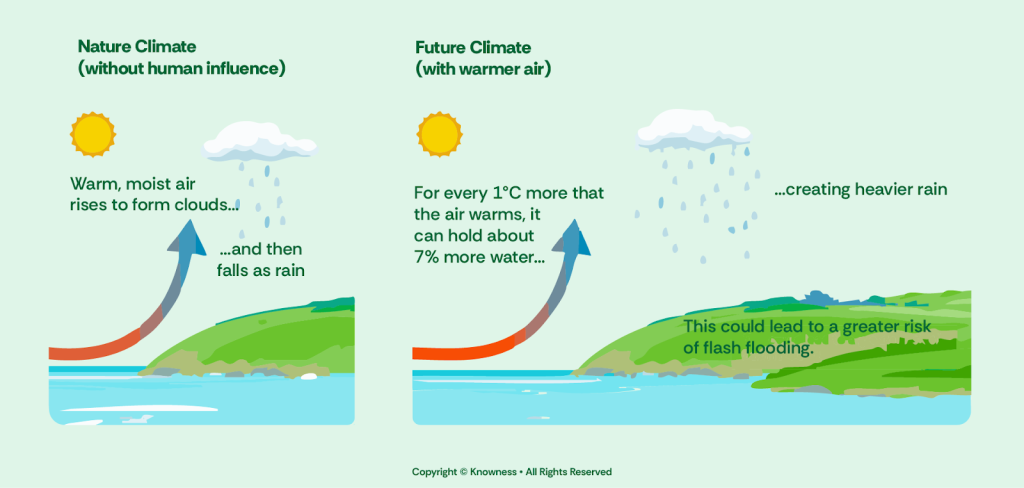
Warmer air temperature due to climate change means more water vapour can be held. This is because warmer air has more kinetic energy, causing its molecules to move faster and further. Air moisture acts as fuel for tropical storms. This can mean that storms can hold more moisture, subsequently intensifying a tropical storm noticeably from an increase in precipitation.
Climate change can alter in wind patterns and therefore the movement and trajectory of tropical storms.