

1.1.10 Climate Change
In this lesson, we will explore the evidence for climate change throughout the last 2.6 million years (known as the quaternary period), discuss the possible causes of climate change, including natural factors and human activities, and provide an overview of the effects of climate change on people and the environment.
The Challenge of Climate Change
Climate change is one of the most urgent and complex challenges facing the world today. It refers to long-term shifts in global temperatures and weather patterns, largely driven by human activities such as burning fossil fuels, deforestation, and industrial processes. These activities increase the concentration of greenhouse gases in the atmosphere, leading to global warming and changing climate systems.
Evidence for Climate Change
Climate change is not a recent phenomenon but has occurred throughout Earth’s history. Evidence for climate change comes from a variety of sources, including geological records, ice cores, and historical data. The following is an overview of evidence for climate change:
- Geological evidence, such as sediment layers, fossils, and rock formations, provides insights into past climate conditions and how they have changed over time.
- Ice cores drilled from polar ice caps contain trapped air bubbles and isotopic compositions that can be analysed to reconstruct past atmospheric conditions and climate patterns. These and Geological records are known as proxy data.
- Historical records, such as temperature measurements, rainfall records, and even observations of natural phenomena, offer valuable information about changes in climate over the past few centuries. This can include paintings, diaries, or poems.
- Tree rings, with each ring representing one year of growth and the thickness of the ring reflects environmental conditions during that year. Wider rings reflect warm and wet conditions whereas more-narrow rings are indicative of cold and dry conditions.
Possible Causes of Climate Change
Climate change is influenced by both natural factors and human activities. The following are possible causes of climate change:
Natural Factors
Variations in Earth’s orbit around the sun, known as Milankovitch’s theory, lead to changes in the amount and distribution of solar radiation reaching the Earth’s surface, affecting climate patterns over long periods.
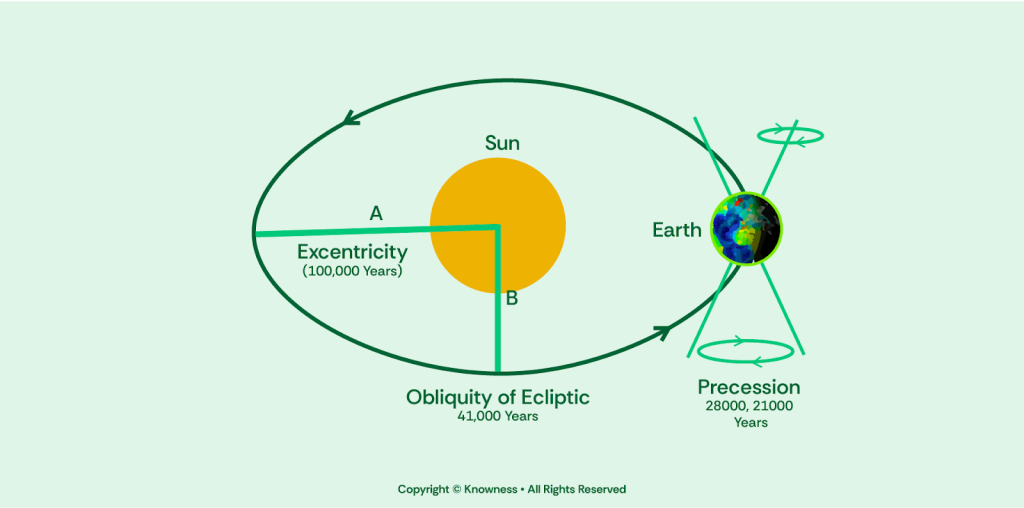
Volcanic eruptions also release large amounts of gases, aerosols, and particles into the atmosphere, which can scatter and absorb incoming solar radiation, resulting in temporary cooling effects. Furthermore, variations in the sun’s energy output, such as changes in solar radiation and sunspot activity, can also influence Earth’s climate on different timescales.
Greenhouse Effect
The greenhouse effect refers to the natural process whereby certain gases in Earth’s atmosphere trap heat, warming the planet to a temperature suitable for life. From incoming solar radiation, roughly only 70% of that is absorbed by land, oceans, and the atmosphere, the other 30% is reflected back into space by clouds, atmospheric particles, and Earth’s surface.
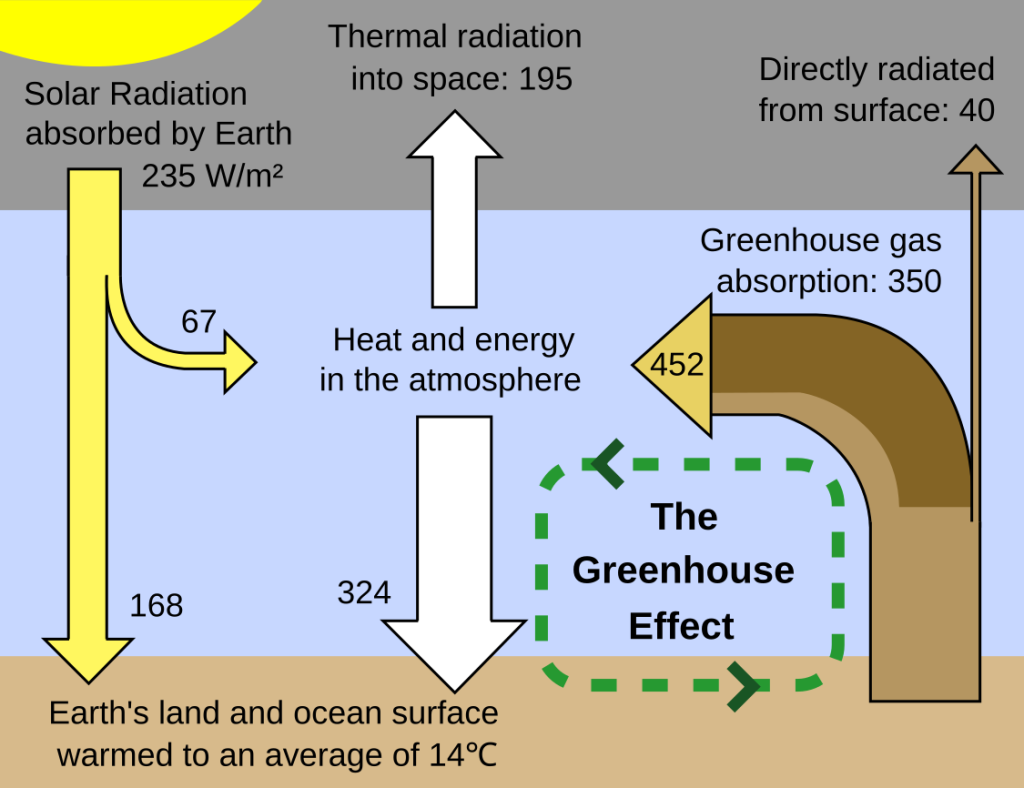
The reflected solar radiation is trapped from the greenhouse effect, effectively warming the planet to a surface average temperature of 14°C. Without it, global surface temperatures would be approximately -18°C.
Enhanced Greenhouse Effect
The greenhouse effect is a natural process, however, due to human activities more greenhouse gases are released into the atmosphere that contribute to an enhanced greenhouse gas effect.
Burning fossil fuels, such as coal, oil, and natural gas, releases carbon dioxide (CO2) into the atmosphere. Pre industrial revolution, the Earth saw around 280 parts per million (ppm), however current levels are around 420 ppm. (around a 50% increase).
Agricultural practices, such as deforestation for the purpose of livestock farming plays a significant role in the increase in carbon emissions. Trees and other vegetation take in carbon dioxide, however it is common practice for forests to be cut down for logging, urbanisation, or the expansion of crops and livestock. When chopping down a tree or burning wood, the carbon that was stored from photosynthesis is released into the atmosphere.
Using farm animals, predominantly cows, emit methane through their digestive system. Methane is a highly toxic greenhouse gas, around 20-30 times more potent than carbon dioxide.
Utilising synthetic fertilisers can release nitrous oxide (\(\ce{N2O}\)) into the atmosphere. Some fertilisers can be transported through runoff water and go into waterways, contributing to water pollution. Production of many synthetic fertilisers, especially ammonia, requires large amounts of energy to be made, also contributing to burning of fossil fuels.
Effects of Climate Change on People and the Environment
Climate change has wide-ranging impacts on both human societies and the natural world. Some key effects include:
- Rising Temperatures: Earth has experienced a 1.1°C – 1.2°C temperature increase since the pre-industrial revolution (roughly 1850-1900). This has contributed towards a pattern of more frequent and intense heat waves, droughts, changes to precipitation, change to growing seasons, water resources and human health.
- Sea-Level Rise: As temperatures rise, glaciers and ice sheets melt, contributing to a rise in sea levels. This can lead to coastal erosion, increased vulnerability to storm surges, and the displacementThe forced removal of people from their land. of coastal communities.
- Extreme Weather Events: Climate change can intensify extreme weather events, such as hurricanes, droughts, floods, and wildfires, resulting in property damage, infrastructure disruption, and threats to human lives.
- Biodiversity Loss: Changes in temperature, precipitation, and habitat conditions can disrupt ecosystems and lead to the loss of biodiversity, impacting plant and animal species.
- Socio-Economic Impacts: Climate change can affect economies, livelihoods, and social well-being through reduced agricultural productivity, disruptions to industries reliant on natural resources, increased healthcare costs, and challenges for vulnerable communities.
Just like with natural hazards, the effects of climate change are not spread evenly. For example, the north polar regions are likely to see much more warming than the rest of the planet. Low-lying regions may feel the effect of climate change more, due to their proximity to coastal erosion, flooding, and the contamination of water systems.